
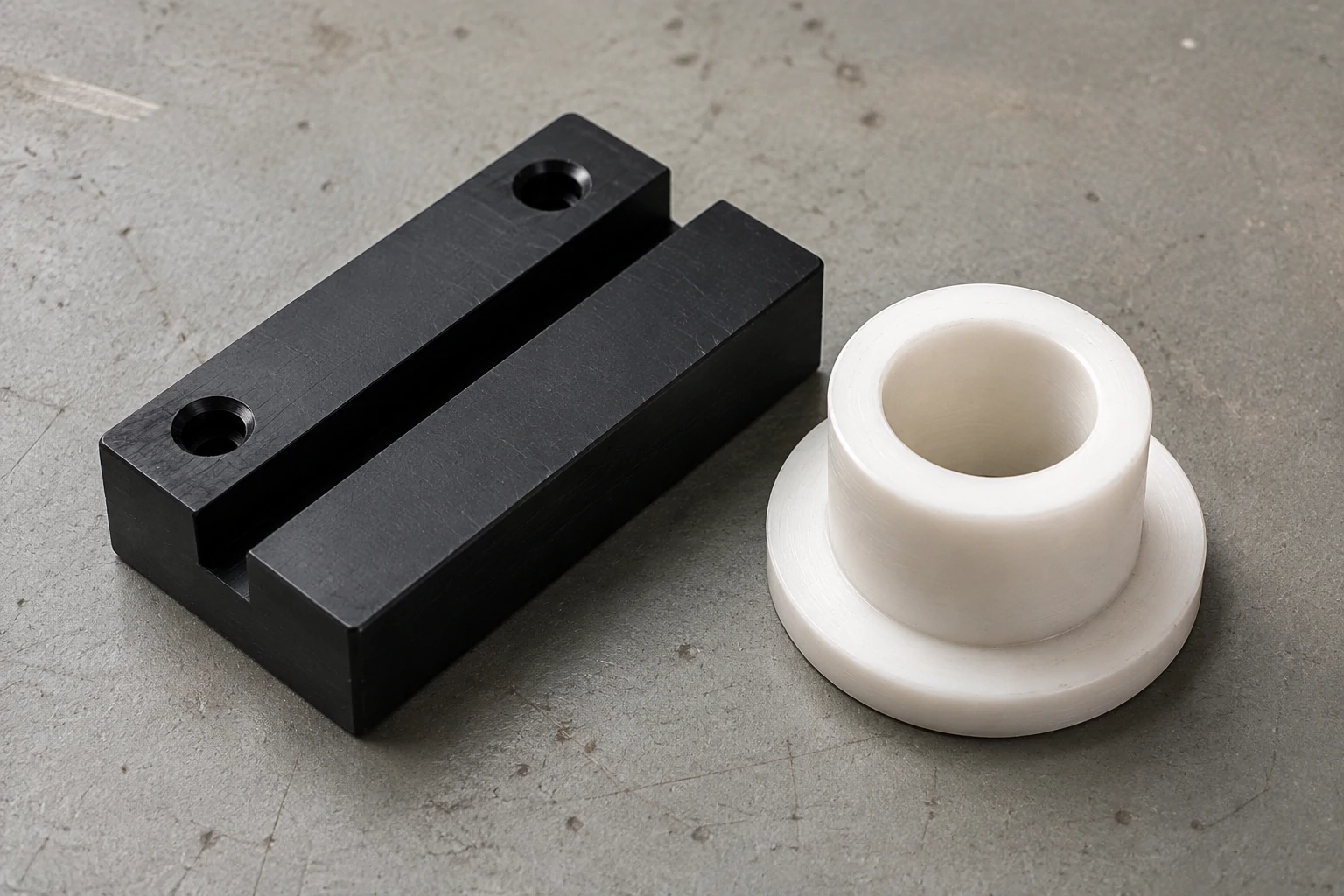
CNC machining engineering plastics can be a sensible choice when a component needs low weight, electrical isolation, a nonmetal contact surface, or particular friction and chemical characteristics. The decision must follow the actual material grade and operating conditions. Replacing an aluminum or steel part with an identically shaped polymer part does not preserve stiffness, dimensional behavior, or long-term load response automatically. This article explains how to evaluate machined guides, sleeves, spacers, and insulating blocks for industrial equipment, with attention to material data, geometry, machining condition, and acceptance rather than a simple metal-versus-plastic price comparison.
When does CNC machining engineering plastics make sense?
It makes sense when the application needs a property that the selected polymer can provide and the part can be designed around its limitations. Begin with the contact, load, temperature, environment, and service-life requirements. Then assess a specific grade and stock form against them.
A guide block contacting a moving component may need a suitable sliding surface without an added coating. An electrical spacer may need a documented insulating function. A handling fixture may need low mass or a contact surface that avoids marking a product. These are different applications and should not be grouped under a vague request for strong plastic.
The materials overview helps organize the initial discussion. A material family name is only the beginning. Confirm the grade, fillers or reinforcement, stock condition, color if functionally relevant, and the supplier's current material data. Similar-looking black or white components can be made from substantially different polymers.
Define service conditions before choosing a material family
Choose material from the environment the component will actually experience. Temperature, moisture, cleaning fluids, load duration, sliding contact, and assembly restraint can all matter. A room-temperature sample that fits once is not enough to establish suitability throughout service.
Write down normal conditions and foreseeable changes separately. Identify whether a sleeve runs continuously or only during adjustment, whether a spacer carries sustained clamp load, and whether a guide is exposed to a wash or cleaning cycle. Avoid substituting a supplier's maximum temperature figure for an application review; such values have specific test conditions and meanings.
For chemical exposure, identify the actual fluid, concentration, temperature, and contact duration. For electrical requirements, specify the relevant property and acceptance evidence instead of relying on appearance. Where the application requires a particular material declaration or test result, confirm availability for the exact grade and supply route before ordering.
| Application input | Why it matters to the decision | Information to provide |
|---|---|---|
| Sustained or intermittent load | Geometry must support the intended service behavior | Load direction, duration, and restraint |
| Temperature range | Fit and dimensional condition may change | Normal operation, startup, and cleaning conditions |
| Moisture or fluid exposure | Material response is grade and condition dependent | Fluid identity, duration, and environment |
| Sliding contact | Wear behavior depends on the mating system | Counterface, motion, speed, and lubrication conditions |
| Electrical function | A material name alone does not define acceptance | Required property, test basis, and documentation |
Do not transfer a metal drawing unchanged
A polymer alternative needs a design review, even when the outside envelope must remain the same. Support, wall thickness, fastener contact, and dimensional allowances may need to change. The appropriate response depends on the material data and the component's function.
Consider a slotted guide block secured by two screws. The design needs enough supported material around the fasteners and a clear definition of the sliding interface. Tightening the screws should not unintentionally become the method of forcing an unstable block into its nominal shape. If the assembly relies on a particular clamp load or insert, record that requirement explicitly.
A sleeve replacing a metal bushing also needs the mating shaft, housing condition, and operating environment identified. The same nominal bore does not automatically create the same running fit. Review the hole tolerances and fits guide alongside material-specific data rather than copying a metal fit designation without checking its intended function.
Machining condition affects dimensional interpretation
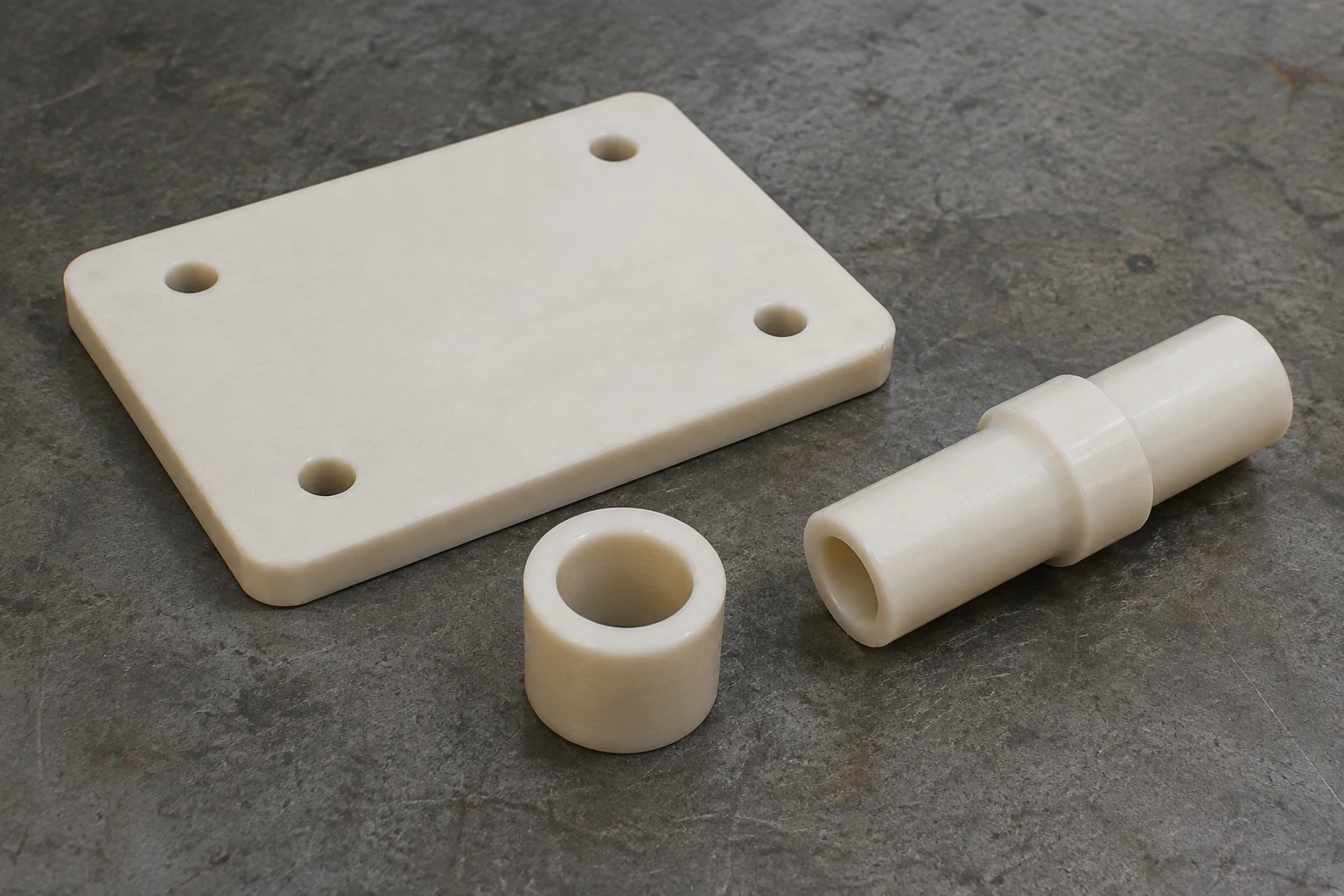
Heat, material condition, and restraint deserve attention when planning a polymer component. Ensinger's machinable plastics FAQ discusses thermal behavior, moisture effects, and residual stress as material-dependent considerations. These are reasons to define the machining and inspection condition, not reasons to assume that every plastic needs the same treatment.
Ask the supplier how the proposed stock and geometry will be supported during machining and how final dimensions will be checked. A measurement taken while a part is compressed in a fixture may answer a different question from a measurement on the released part. A dimension checked immediately after an operation may also need a defined stabilization condition for the agreed acceptance method.
Do not prescribe a universal annealing cycle, cutting parameter, or cooling method from a general article. Those decisions depend on the polymer grade, stock producer's guidance, tool arrangement, and required condition. If stress relief or conditioning is needed, define it in the process agreement and identify when the final measurement takes place.
Separate useful precision from unrealistic specification
A polymer component should have tolerances that protect its function in a defined condition. Applying the tightest metal-part tolerance everywhere can add machining and inspection work without establishing the required in-service fit. The operating environment may matter more than a single measurement at receipt.
Mark the features that locate, slide, insulate, or carry load. Define the mating components and the relevant assembly state. Then distinguish those interfaces from clearance surfaces and exterior geometry. A precise external envelope may be necessary for installation, but it should be connected to an actual requirement rather than copied from an old drawing by habit.
Discuss measurement contact and support as part of the inspection plan. The quality control overview provides a framework for identifying characteristics and evidence. The method must suit the material and geometry; displaying additional decimal places does not make an unsuitable measurement arrangement more informative.
Review threads, inserts, and clamping interfaces together
Fastener design should account for the load path and the selected material. A directly machined thread, a through bolt, and an insert create different interfaces. None should be chosen solely because it is the easiest feature to copy from an existing metal part.
Provide the intended fastener, engagement, assembly frequency, and access. If an insert is needed, specify the insert system and installation requirements, or explicitly request a design review. A generic insert note leaves unanswered questions about hole preparation, retention, surrounding material, and inspection.
For a spacer, identify the contact faces and whether the fastener load passes through the polymer or another component. For a guide, identify whether the screws locate the part or only retain it against a separate reference. These distinctions help the supplier understand which faces and holes need controlled relationships and which can use ordinary manufacturing allowances.
Compare cost on the finished function
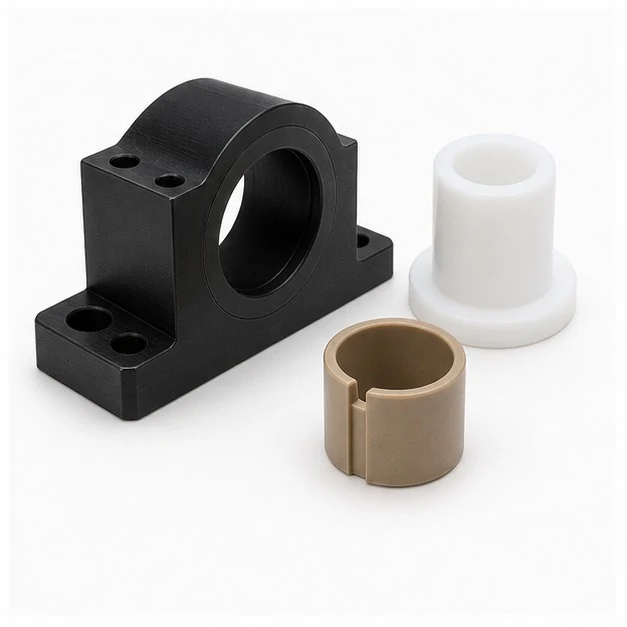
Compare material, machining, inserts, finishing, inspection, and expected replacement conditions for the actual design. A lower stock price does not necessarily produce a lower accepted-part cost. A polymer alternative may require a different geometry or additional preparation, while also removing a coating or separate insulating component.
Keep the alternatives complete. If one design includes a metal sleeve within a polymer block, include both components and their assembly requirements. If a plastic guide is intended as a replaceable wear element, define how it is replaced and what evidence will be used to evaluate service performance. Do not assign an unverified lifetime or maintenance saving to the concept.
For low quantities, machining can allow evaluation without committing to production tooling for another manufacturing process. That is a project-planning advantage, not proof that machining remains the cheapest route at every volume. Reassess the process when geometry stabilizes and the actual demand becomes clearer.
Use a prototype to answer material-specific questions
A prototype should test the uncertainties that made the material choice difficult. For a sliding guide, evaluate the actual contact system and operating conditions. For an insulating spacer, verify the required property and assembly behavior using an appropriate test plan. For a sleeve, evaluate fit across the specified conditions.
Record the exact grade, stock source where required, machining condition, and geometry used in the evaluation. If the production material or route changes, decide whether the original evidence still applies. A sample described only as white plastic cannot support a controlled comparison with a later order.
Define success and failure before testing. A part that fits at assembly but binds during operation may not meet the application need. A part that shows marks may still function, or the marks may be unacceptable in the contact system. Establish the criteria with engineering rather than interpreting the result according to whichever outcome is most convenient.
Build an RFQ that avoids material ambiguity
Include the drawing and model, exact material or clearly labeled candidate grades, quantities, service environment, critical interfaces, finish expectations, and required evidence. If material selection remains open, state the function and ask for candidate review rather than requesting a firm price against an undefined specification.
Separate a material-development request from a production order. The former may involve samples and application testing; the latter needs an approved material definition and acceptance condition. A supplier's suggestion can support selection, but application qualification remains a defined engineering activity with its own evidence.
Identify substitutions explicitly. A quotation should not silently replace one grade with another because the color or family name appears similar. If stock availability requires an alternative, compare the relevant data and decide whether additional validation is needed before accepting the change.
Frequently asked questions
Is machined plastic always cheaper than aluminum?
No. Compare the exact material, geometry, preparation, machining, inserts, and inspection. A polymer can remove an unwanted conductive or contact surface, but the finished functional design determines value rather than the raw-material label alone.
Can the same tolerance apply to metal and plastic parts?
It can only be judged against the specific materials, geometry, environment, and measurement condition. Do not assume the same nominal tolerance produces the same assembly behavior. Identify the functional interface and review the acceptance condition.
Can color identify the polymer grade?
No. Similar colors occur across different materials and formulations. Use the specified grade and required supply documentation. Product photography is useful for illustrating geometry but does not establish material identity or performance.
Should every polymer part be annealed?
No universal rule applies. Follow the stock producer's guidance and the needs of the material, geometry, and required condition. If a treatment is proposed, document its purpose and the point at which final dimensions will be accepted.
Start with the property the metal part cannot provide
A useful polymer alternative solves a defined application problem and carries a clear material and acceptance specification. For an initial manufacturing review, send HongKe CNC your component files and operating conditions, including candidate grades, mating interfaces, quantities, and the evidence needed for evaluation.