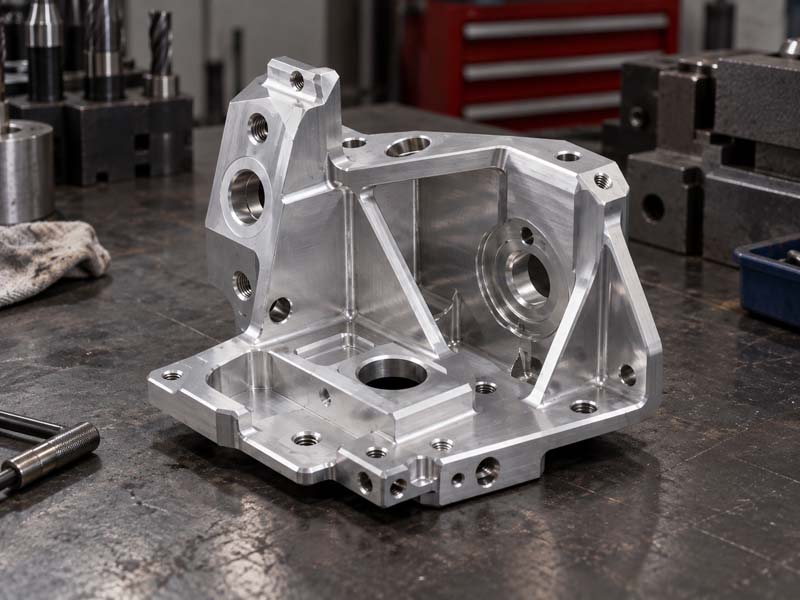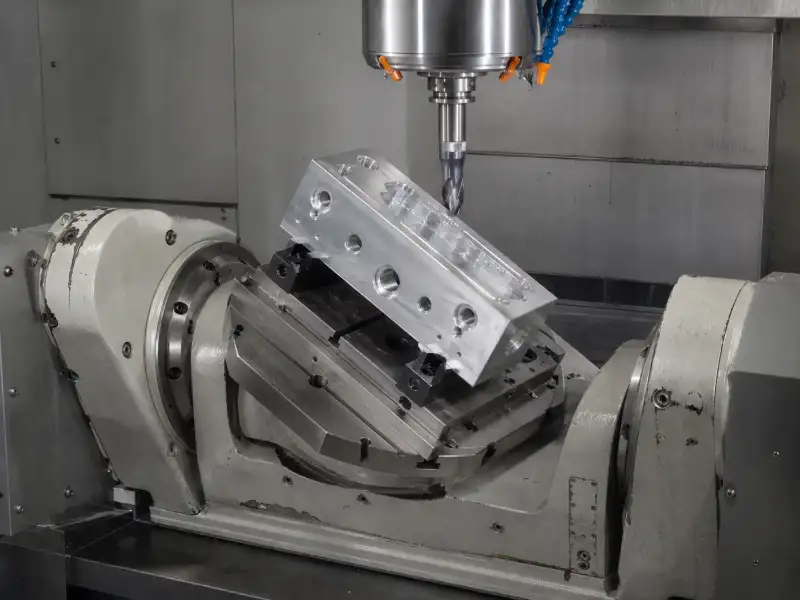
5-axis CNC machining allows cutting tools to approach a workpiece from multiple orientations, making it possible to machine complex geometries that are difficult or impossible with 3-axis machines. However, not every design benefits from 5-axis machining. To fully leverage its capabilities, engineers must understand how part geometry, tool access, workholding, and setup reduction interact. This guide explains the key design considerations for 5-axis CNC machining, helping you make informed decisions during the design phase.
Quick Answer
Design for 5-axis CNC machining focuses on minimizing setups by allowing the tool to reach multiple faces of a part without repositioning. Key design advantages include machining undercuts, complex contours, deep cavities, and angled features in a single setup. However, you must avoid features that force the tool to use an extremely long reach or require excessive overhang. Common design rules: maintain adequate tool clearance, avoid sharp internal corners, and ensure the part can be securely held from the underside or via custom fixturing. 5-axis machining reduces lead time and improves accuracy by eliminating cumulative errors from multiple setups.
Key Takeaways
- 5-axis machining excels at complex geometries: undercuts, freeform surfaces, deep pockets, and angled holes can be machined in one or two setups.
- Reduced setups directly improve positional accuracy and reduce fixture cost, but the part must be designed to allow single-fixture access to all critical features.
- Internal corner radii: always specify a radius large enough to accommodate a standard cutter diameter. The tool tilts in 5-axis, but a very small radius still forces a tiny, fragile tool.
- Avoid deep, narrow cavities with high aspect ratios (depth > 4× diameter), even with 5-axis, because tool deflection becomes significant.
- Workholding: often requires custom soft jaws or vacuum fixtures that clamp on the underside. Ensure the part has a flat, accessible base for fixturing.
When to Choose 5-Axis Machining
5-axis machining is most valuable when your part includes any of these characteristics:
- Complex freeform surfaces (e.g., turbine blades, impellers, mold cavities)
- Undercuts that cannot be accessed from a straight direction
- Deep cavities with angled walls
- Multiple features on different faces that would require several setups on a 3-axis machine
- High precision requirements where stack-up from multiple setups is unacceptable
For simple prismatic parts with only one or two machined faces, 3-axis machining is usually more economical. 5-axis should be reserved for parts where its capabilities reduce total cost through fewer setups or enable geometries otherwise impossible.
Key Design Rules for 5-Axis Machining
Tool Access and Clearance
Even though a 5-axis machine can tilt the tool, every tool has physical limits. The tool holder, collet, and spindle head must not collide with the workpiece or fixture. Design your part so that the tool can approach features from a reasonable angle—ideally less than 45° from vertical. Avoid features that require the tool to be nearly horizontal for long periods, as this reduces rigidity and can cause vibration.
Internal Corner Radii
Small internal radii force the use of small-diameter cutters, which are less rigid and take longer to machine. In 5-axis machining, you can sometimes use a ball end mill with a larger radius, but the principle remains: specify the largest radius that function allows. For general guidance, internal corner radius should be at least 0.5 mm, and preferably 1 mm or more for depths over 10 mm.
Deep Cavities and Pockets
5-axis machining can improve surface finish in deep cavities by tilting the tool to use a more favorable cutting edge angle. However, the depth-to-diameter ratio of the cavity still matters. For cavities deeper than 4× the cutting tool diameter, tool deflection becomes a concern. If your design requires very deep narrow slots or pockets, consider adding reliefs or stepped features to allow shorter tools.
Undercuts and Slots
Undercuts are a natural fit for 5-axis because a tilted tool can reach under features. However, ensure the undercut has enough clearance for the cutter body. The width of the undercut should be at least 50% larger than the tool diameter for reliable chip evacuation. Also, avoid sharp internal corners at the root of undercuts—add a fillet to improve tool life.
Workholding and Part Base
To machine all five accessible sides, the part must be held from the bottom. Design a flat, solid base surface that can be clamped in soft jaws or a custom fixture. Avoid thin, delicate bases that will deflect under cutting forces. If the part has complex geometry on all sides, you may need a sacrificial support tab or a secondary operation, which reduces the benefit of 5-axis.
Common Design Mistakes in 5-Axis Machining
- Overly deep slots with no relief: forces very long tools and poor surface finish.
- Sharp internal corners: require EDM or separate operations.
- Insufficient tool clearance: machine cannot tilt enough without collision.
- Ignoring fixture contact area: part shifts during machining due to small clamping surface.
- Not considering tool holder diameter: bulky holders may hit the part when tilted.
Cost Considerations
5-axis machining typically has higher hourly rates than 3-axis due to machine investment and programming complexity. However, the total cost for a part may be lower if it would otherwise require multiple 3-axis setups, special fixtures, or post-machining handwork. Ask your machining partner for a quote comparison between 3-axis and 5-axis approaches for your specific geometry. Often, the breakeven point is around three setups: if your part needs more than three setups on a 3-axis machine, 5-axis becomes attractive.
What This Means for Your Part
Before finalizing your design, review it from the perspective of a 5-axis programmer: Can all features be accessed with a reasonable tool length? Are the internal radii consistent? Is there a clean base for fixturing? If you are unsure, provide your 3D model and 2D drawing to a capable CNC machining partner like HongKe CNC for an engineering review. They can advise whether 5-axis machining is appropriate and suggest minor design tweaks to optimize cost and quality.