
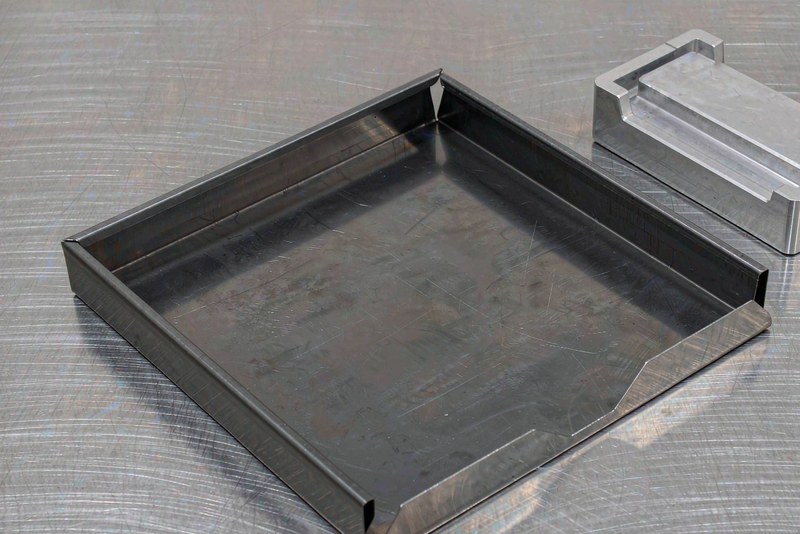
The useful answer to sheet metal vs CNC machining is that neither route is cheaper in the abstract. One begins as a flat blank and is folded; the other begins as solid stock and loses material until the part appears. That difference decides which geometries are cheap and which tolerances hold.
Sheet Metal vs CNC Machining: Where the Routes Diverge
Fabrication starts with a flat pattern cut from coil or plate, then formed on a press brake or in a stamping die. Wall thickness is whatever the sheet is, and it stays constant. Machining starts with a billet, so thickness becomes a design variable.
A formed part cannot grow a thick boss, a deep pocket, or an internal undercut without adding a separate piece. A machined part can, but every cubic centimeter of stock removed costs spindle time.
Tolerance accumulates differently. On a formed part it builds through the bend sequence, because springback and fold order move hole positions; on a machined part a feature lands where the program puts it.
What Sheet Metal Fabrication Handles Well
Laser cutting and punching produce a flat blank with holes, slots, and cutouts in one operation, and a design change is a program edit rather than a new die, which suits brackets, panels, covers, and mounting plates.
Typical practice keeps formed parts under roughly three millimeters of gauge thickness, because a thin panel deflects under cutting loads.
Press brake forming imposes rules designers underestimate. A hole too close to a bend line distorts, so most shops keep hole edges at least a material thickness plus the inside bend radius from the bend, and reliefs prevent tearing at flange ends.
Self-clinching fasteners let a formed assembly carry threads without machining, and supplier-coordinated powder coating adds a film to a constant-thickness part.
What CNC Machining Handles Well
Machining wins wherever the geometry is not a folded surface: bored seats, counterbores with controlled depth, tapped holes on a pattern, and faces that must stay flat under load.
It also wins on section changes. A housing needing a heavy wall in one zone and a thin web in another has no sheet metal equivalent without inserts and welding, which brings distortion.
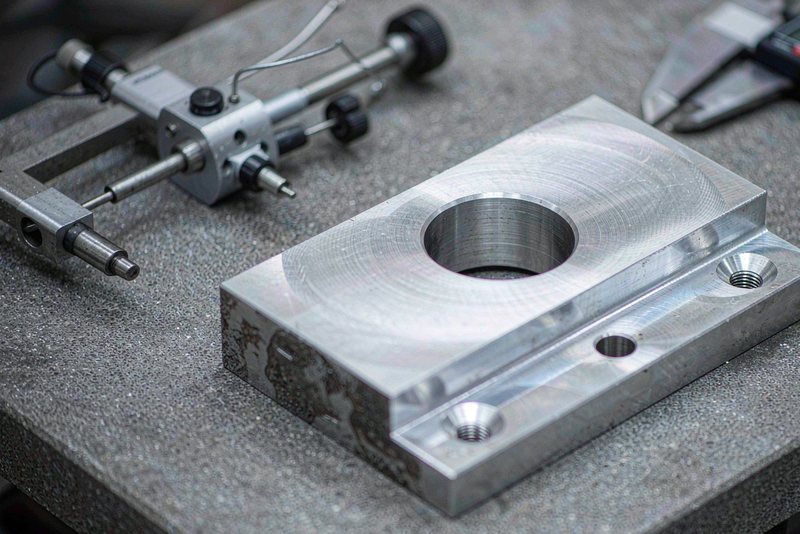
Tolerance on selected critical features is the other reason parts move to machining. Tolerances in the range of a few hundredths of a millimeter are achievable on selected critical features, depending on material, geometry, workholding, process route and inspection requirements.
The cost structure is inverted: tooling is modest, but each part carries a full cycle time, so machining suits prototypes up to a few hundred pieces.
Cost per Part: Where the Crossover Sits
The crossover is not one quantity but a set of thresholds: programming and brake setup dominate the first parts, cycle time the middle, hard tooling the top.
| Quantity band | Sheet metal route | CNC machining route |
|---|---|---|
| Under about 25 | Setup spread over few parts | Competitive on simple geometry |
| Roughly 50 to 500 | Setup amortized, cost falls sharply | Cycle time dominates, cost is linear |
Fabrication pulls ahead on boxy parts in that middle band. A bracket machined at ten pieces can often be redesigned as a folded part at two hundred, if the tolerance intent survives the change. The same trade-off for smaller solid parts appears in this comparison of cold heading, stamping, and machining.
Machining cost also scales with stock removal, so near-net stock can undercut a folded assembly at moderate quantity; CNC machining cost by quantity covers that.
Tolerance, Finish, and Edge Condition
Sheet metal tolerances are usually quoted as general tolerances across the drawing. Cut features commonly land within a couple of tenths of a millimeter and bend angles within about a degree, with bend-to-bend dimensions wider because each bend adds error.
Edge condition is the part buyers forget. A burr on laser-cut or sheared edges becomes a flatness problem on a mating face after assembly, and deburring is a real line item at inspection.
Finishing changes dimensions on both routes. Powder coating can bridge small holes and load threads, and anodizing grows into a bore by roughly half its thickness per surface, so a locating bore needs a mask note or a pre-finish allowance.
A tighter tolerance on a machined part means a finishing pass and more inspection, which is why tight tolerances carry a cost premium.
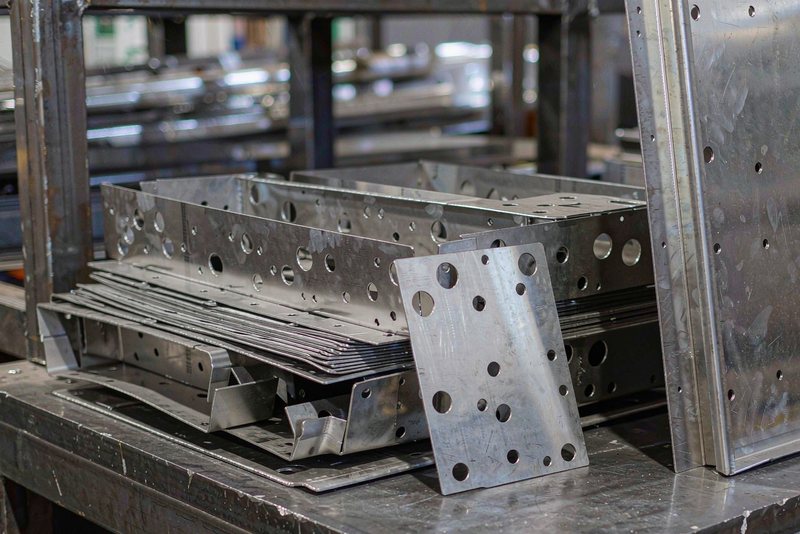
Hybrid Routes: Formed Skins With Machined Features
Many production parts are neither pure fabrication nor pure machining. The common pattern is a formed or welded body with a machined interface: a mounting face milled flat after welding, or an insert pressed into a folded bracket.
The rule is to machine features, not volumes. Where a part needs flatness on one face and stiffness elsewhere, welding a plate onto a folded body and machining that face costs less than cutting the shape from solid.
The route affects schedule too, since the part queues at the weld, at stress relief, and again at the machine, which is why CNC machining lead time is quoted per route.
A Decision Checklist Before You Send an RFQ
Run through these before the drawing goes out, and the quote comes back on the route you want.
- Wall thickness is constant and under about three millimeters, and every feature is reachable from the flat.
- The part is panel-like rather than a solid with pockets and bores.
- Quantity is high enough that programming and forming setup amortize.
- No feature needs a tolerance tighter than general fabrication holds.
- Edge condition and deburring are called out, not assumed.
If two or more fail, the part likely belongs on a machining center. If all hold, fabrication is cheaper, and a machined version pays for capability the part does not use.
The Short Version
Sheet metal vs CNC machining is a question about shape and count, not about which process is better. Folded parts win on constant-thickness, panel-like geometry at volume; machined parts win on solid geometry, precise features, and low quantities. Most expensive mistakes happen at the drawing stage, where a tolerance or an edge condition is left to interpretation.