
Quick Answer
17-4 PH stainless steel (grade 630, UNS S17400) is a martensitic, precipitation hardening stainless steel that reaches high strength without a high carbon content. In CNC machining the condition matters more than the alloy: 17-4 PH condition A cuts like a tough 300-series stainless, while H900 at roughly 40 HRC has to be turned slowly or ground. The usual route is to machine in condition A, age to the specified condition, then finish any tight features.
Key Takeaways
- Condition A is the softest supply state and the easiest to machine; every step up the aging ladder adds hardness and cutting cost.
- H900 aging gives the highest strength and the worst machinability, while H1150 gives up strength and becomes noticeably easier to cut.
- Aging shrinks the part on the order of 0.0005 in/in, so leave stock and finish after heat treatment when tolerances are close.
- 17-4 PH is magnetic in every condition, unlike 304 or 316.
What 17-4 PH Stainless Steel Actually Is
17-4 PH is a martensitic stainless steel in the chromium-nickel-copper family: roughly 16% chromium, 4% nickel and 4% copper, with a niobium addition. The common name comes from the 17% Cr / 4% Ni formulation of the original grade. It is bought as bar, plate and forgings under ASTM A564 grade 630, and aerospace work is commonly ordered to AMS 5643.
Hardness does not come from carbon here, which is held near 0.07% to keep the martensite tough. Strength comes from copper-rich precipitates that form during a low-temperature age, and that is why a part can be machined soft and hardened afterwards with little distortion. Corrosion resistance sits close to 304 in mild and atmospheric service, and it is not a substitute for 316 where chlorides are present.
Condition States Drive Machinability
The condition is the heat treatment state a part is delivered in or aged to. Five appear regularly in machining work.
| Condition | Aging cycle | Typical hardness | Machining behavior |
|---|---|---|---|
| A (solution annealed) | none | low 30s HRC | stringy chips, work hardens if rubbed |
| H1025 | 1025 °F (552 °C), 4 h | mid 30s HRC | balanced strength and tool life |
| H1150 | 1150 °F (621 °C), 4 h | around 30 HRC | toughest, most forgiving to cut |
| H900 | 900 °F (482 °C), 1 h | 40 HRC and above | slow speeds, rapid insert wear |
The pattern is consistent: as the aging temperature rises, strength falls and toughness and machinability improve. H900 is specified for maximum strength; H1025 and H1150 fit parts that still need machining after aging.
Machining 17-4 PH in Practice
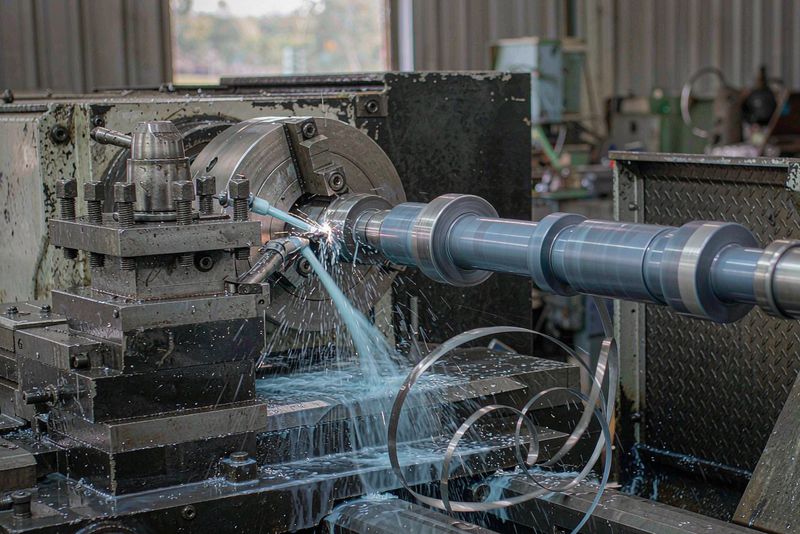
In condition A the alloy produces a heavy, stringy chip and work hardens quickly, which is where most trouble starts. Typical practice is a sharp positive-rake carbide insert, a depth of cut that stays under the hardened layer, and constant feed. Dwelling or sparking out on the surface hardens it and dulls the next pass.
Flood coolant at high pressure is normal because the material holds heat; a starved cut shows up as insert cratering. Small taps are the weak point. Form tapping in condition A is more reliable than cut tapping, and in H900 thread milling avoids a broken tap inside an expensive part. Thin walls and long shafts deflect under tool pressure, so support them instead of adding extra finishing passes.
Aging After Machining: What Actually Moves
Aging is not dimensionally neutral. The transformation shrinks the part, typically by about 0.0004 to 0.0006 in/in in H900 and somewhat less in the overaged conditions. On a 100 mm bore that is a few hundredths of a millimeter, which is enough to lose a fit.
Two rules follow. Put stock on surfaces that must hold a tolerance and finish them after aging. Do not blame the age for everything either: residual stress from roughing distorts a thin part more than the age does, so stress relief before finishing is often the more useful step.
17-4 PH vs 316 Stainless Steel
Choose by what the part has to survive. H900 delivers yield strength several times that of annealed 316, which is why 17-4 PH shows up in shafts, valve stems, fasteners and airframe fittings. 316 still wins wherever chlorides, marine air or cleaning chemicals are involved; 17-4 PH behaves closer to 304 there and will pit in conditions that 316 tolerates.
Cost runs the other way. 17-4 PH bar typically costs more than 304 and at least as much as 316, cutting speeds are lower, and the age adds a lot charge. For a part that only needs corrosion resistance, 316 is usually cheaper, and the 304 vs 316 stainless steel comparison covers where its molybdenum earns the price. If free machining matters more than strength, 303 or 416 cuts faster, and the wider CNC machining materials guide puts those trade-offs next to aluminum and titanium.
Cost and Inspection Notes
Machining time dominates the cost of a 17-4 PH part, not the bar price. Hardened conditions shorten tool life, and H900 parts often need a finish grind on fits; neither is visible in a quote unless the condition is stated. Small quantities also carry a full heat-treat lot charge, so the per-part premium on a five-piece order is far larger than on a five-hundred-piece order.
Inspection follows the same logic. Chemistry and condition belong on the mill certificate, hardness should be checked on every lot rather than assumed from the paperwork, and dimensions should be re-checked after aging rather than before. Because the alloy is magnetic, magnetic particle inspection is available where a drawing calls for it. A first article inspection repeated after heat treatment is what separates a real capability claim from a dimensional report taken at the wrong stage. Where tolerances sit near the process limit, the cost of holding tight tolerances is worth budgeting before the drawing is released.
FAQ
Is 17-4 PH stainless steel magnetic?
Yes. It is martensitic and magnetic in condition A and after aging, so it cannot be used where a non-magnetic stainless is required.
Can 17-4 PH be machined after aging?
It can, but hard turning and grinding replace conventional milling, and tool life drops sharply in H900. Most shops machine in condition A and age afterwards.
Which condition should a drawing specify?
H1150 or H1025 covers most parts that still need machining after aging; H900 only where strength is the design driver. State both the condition and the governing material specification.