Quick Answer
6061 and 6082 are both 6xxx-series aluminum, and on a drawing they look interchangeable: similar density, similar strength, similar behavior under a cutter. The differences are metallurgical and logistical. 6061-T6 is the North American plate alloy, carries copper, and takes anodizing predictably. 6082-T6 is the European bar and extrusion alloy, silicon-rich and manganese-bearing, with better metric stock availability. Choose by mill product form, temper and finishing route, not by a strength figure within a few percent.
Key Takeaways
- 6061-T6 and 6082-T6 published minimum strengths sit in one band; 6061 is slightly higher in yield.
- 6082 carries about 1% silicon and 0.5% manganese, no copper; 6061 carries copper, which shifts anodizing response.
- Availability decides most swaps: 6061 plate in North America, 6082 in European metric bar.
- Residual stress in the stock, not alloy strength, moves parts after the last pass.
- A grade swap is a drawing change and needs documented approval.
6061 vs 6082 Aluminum: Where the Difference Actually Shows
Both are heat-treatable Al-Mg-Si materials strengthened by magnesium silicide, so a machinist can run either with the same tools and roughly the same parameters. The differences sit in the minor additions.
6061 (EN AW-6061, formerly AlMg1SiCu) adds copper and a little chromium, which raises strength after aging and changes how the material responds to chemical finishing. 6082 (EN AW-6082, formerly AlMgSi1) swaps that copper for about 0.5% manganese and carries more silicon — around 1% against roughly 0.6% in 6061.
That swap explains what engineers notice: 6082 is a little more corrosion-tolerant and easier to weld, while 6061 has decades of anodizing experience behind it. Product form separates them more sharply: 6082 is stocked as metric extrusion and bar, 6061 as rolled plate.
Strength, Temper and Product Form
In T6 the two are close enough that a drawing reading "6061-T6 or equivalent" quietly allows either. Published minimum yield strengths differ by a few percent, with 6061 usually the higher.
Temper designations settle more disputes than alloy numbers. Rolled 6061 plate commonly arrives as T651, stress-relieved by stretching after solution treatment, which keeps large plates flat through heavy removal. Extruded 6082 bar arrives as T6 or T6511, its residual stress following the extrusion direction. A plain T6 callout with no product form can be met by stock that behaves differently.
Write the requirement as alloy, temper, product form and minimum properties, then have the supplier confirm what the mill certificate states. Where strength is critical, ask for tested values rather than a handbook figure.
Machining Behavior: Chips, Distortion, Tool Life
On a three-axis mill the two cut alike where it matters: sharp polished flutes, high surface speed, generous coolant, rigid setup. Higher silicon makes 6082 slightly more abrasive on carbide, and shop-floor opinion splits — some machinists report 6082-T6 cutting freely, others index inserts sooner on long runs.
Distortion traces back to stock rather than alloy. A stress-relieved 6061-T651 plate tolerates aggressive pocketing with modest movement; the same geometry in extruded 6082 bar may bow as internal stress rebalances. Thin ribs amplify this, which is why minimum wall thickness guidelines matter more than alloy choice on slender parts. Roughing both sides, letting the part rest, then finishing is the usual countermeasure on flatness-critical work.
Anodizing and Cosmetic Response
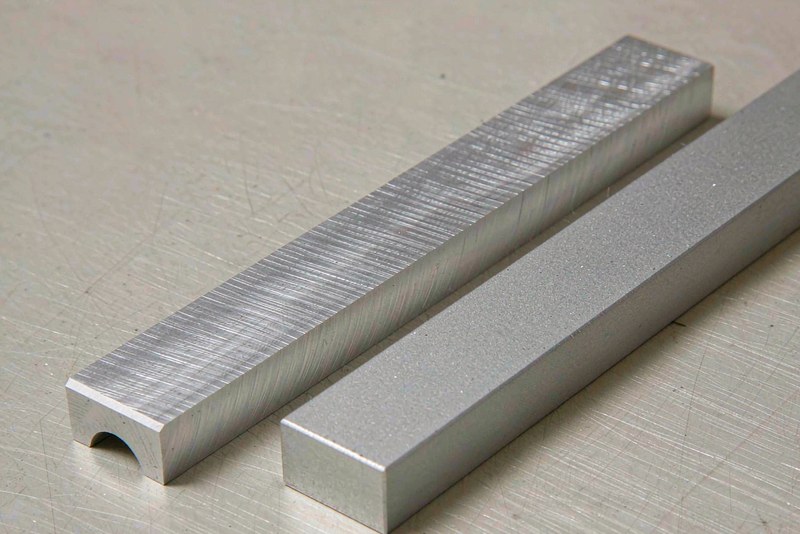
Anodizing reacts to alloy chemistry, and here the two stop looking equivalent. Copper in 6061 tends to give deeper, more saturated color in dyed finishes and a warmer grey when clear. 6082, with silicon and manganese and no copper, reads lighter and cooler. The gap is most visible where two batches sit side by side, and least visible on internal brackets nobody inspects under a color light.
As-machined tool marks also show through thin anodic coatings, so finish and machining finish are agreed together. Settling the Ra and Rz callouts at quotation stage avoids stripping and recoating, and where a class or color standard applies, the alloy belongs on the drawing beside it.
Approving a Substitution
Substitution happens for ordinary reasons: the mill is out of a thickness, or a European drawing lands in a North American shop. The mechanical case is easy; the documentation is what gets skipped.
- Form and temper. A 6082-T6 extrusion is not a drop-in for 6061-T651 plate; match form and stress-relief condition.
- Properties. Check yield, elongation and hardness against drawing minimums; ask for tested values where strength is critical.
- Finishing and service. Confirm anodizing class and color acceptance before cutting metal; copper-free 6082 behaves differently in marine or chemical exposure.
- Written approval. A substitution is a deviation: record it, sign it, reference it on the report.
The sequence runs form, then temper, then properties — the reasoning behind choosing between 6061 and 7075, and the questions a 304 vs 316 decision raises for stainless.
Common Mistakes
Treating "or equivalent" as permission. An equivalence clause asks for engineering review; it is not a license to substitute silently.
Quoting strength from memory. Handbook values describe one temper and one product form. If the drawing says T6 and the stock is T651, those numbers may not describe the material in the machine.
Ignoring stock stress. Parts that move after machining are reacting to residual stress in the blank. A tighter finished tolerance does not address that cause.
FAQ
Is 6082 a direct replacement for 6061?
Mechanically it is close, and both are 6xxx alloys in the T6 condition. It is not a paperwork-free swap: form, temper, stress relief and anodizing response all change.
Which alloy machines faster?
Neither has a clear general advantage. 6082's higher silicon can be slightly more abrasive on carbide, while 6061 is well understood in most shops.
Can 6061 and 6082 be anodized to the same color?
Not reliably in the same batch. Copper in 6061 and the silicon-manganese combination in 6082 give different color response, particularly in dyed finishes.