
Introduction
Selecting the right material is one of the most critical decisions in any CNC machining project. The material directly influences part strength, weight, corrosion resistance, surface finish, and overall cost. Whether you are designing a prototype or planning full-scale production, understanding the key properties of common CNC materials will help you make informed choices that align with your functional requirements and budget.
This guide provides an in-depth comparison of the most frequently used materials in precision CNC machining, highlighting their machinability, typical applications, and design considerations. We will also discuss how material choice affects tolerance, surface finish, and lead time.
Aluminum Alloys
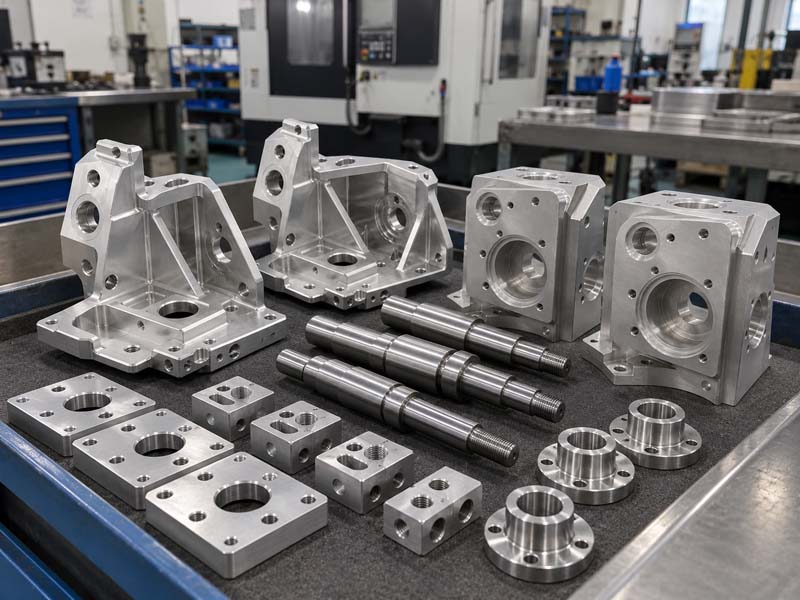
Aluminum is by far the most popular material for CNC machining due to its excellent machinability, good strength-to-weight ratio, and natural corrosion resistance. Common grades include 6061, 7075, and 5083.
6061 Aluminum
6061 is the workhorse of CNC machining. It offers good strength, weldability, and surface finish. It is ideal for structural components, brackets, enclosures, and custom parts where moderate strength and low cost are priorities. 6061 can be anodized to improve wear resistance and appearance.
7075 Aluminum
7075 has higher strength (comparable to some steels) and is used in aerospace and high-stress applications. However, it is more difficult to machine and more expensive than 6061. It is often chosen for components like aircraft fittings, gears, and shafts.
Machining Characteristics
Aluminum chips are easy to break, allowing high cutting speeds and excellent surface finishes. Tools last longer compared to steel machining. The material can achieve tight tolerances (±0.005 mm typical) and complex geometries. Thermal expansion is moderate but should be considered for precision parts.
Stainless Steel
Stainless steel is chosen for its superior corrosion resistance, strength, and hygienic properties. Common grades in CNC machining are 303, 304, and 316.
303 Stainless Steel
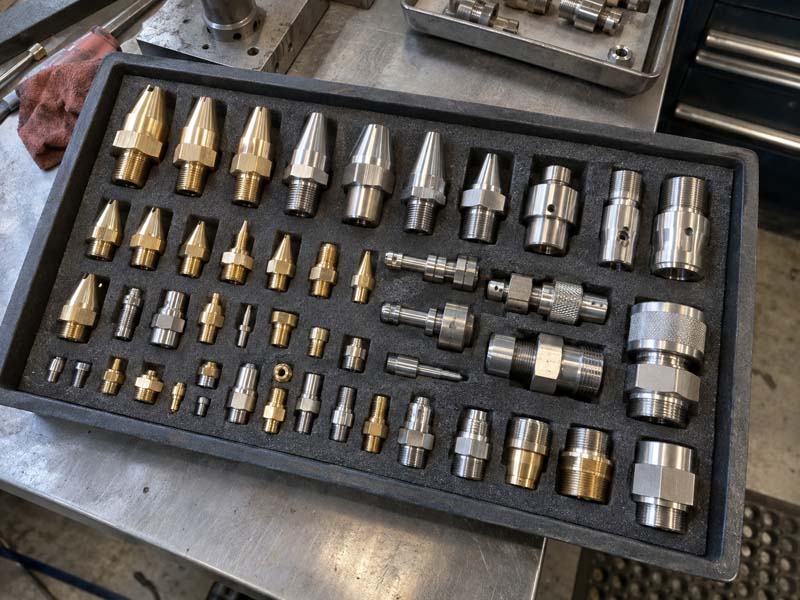
303 is a free-machining grade with added sulfur to improve chip breaking. It is the easiest stainless steel to machine and is used for fittings, bushings, and nuts/bolts. It has good corrosion resistance but not as high as 304 or 316.
304 and 316 Stainless Steel
304 is general-purpose, offering excellent corrosion resistance and formability. 316 contains molybdenum, giving it superior resistance to chlorides and marine environments. Both are tougher to machine than 303, requiring slower speeds and rigid setups. They are common in medical devices, food processing equipment, and architectural components.
Machining Considerations
Stainless steel tends to work-harden, so aggressive feeds and sharp tools are essential. Coolant is required to prevent heat buildup. Surface finishes can be polished or passivated. Tolerances of ±0.01 mm are achievable with proper tooling.
Brass and Copper Alloys
Brass is highly machinable, producing excellent surface finishes with minimal tool wear. It is often used for electrical connectors, plumbing fittings, decorative hardware, and small precision components.
Machinability
Brass (e.g., C36000) is one of the easiest metals to machine, allowing high speeds and feeds. It produces small, easily handled chips. Copper (C110) is softer and more gummy, requiring sharp tools and good chip evacuation. Both materials can achieve very tight tolerances and fine threads.
Engineering Plastics
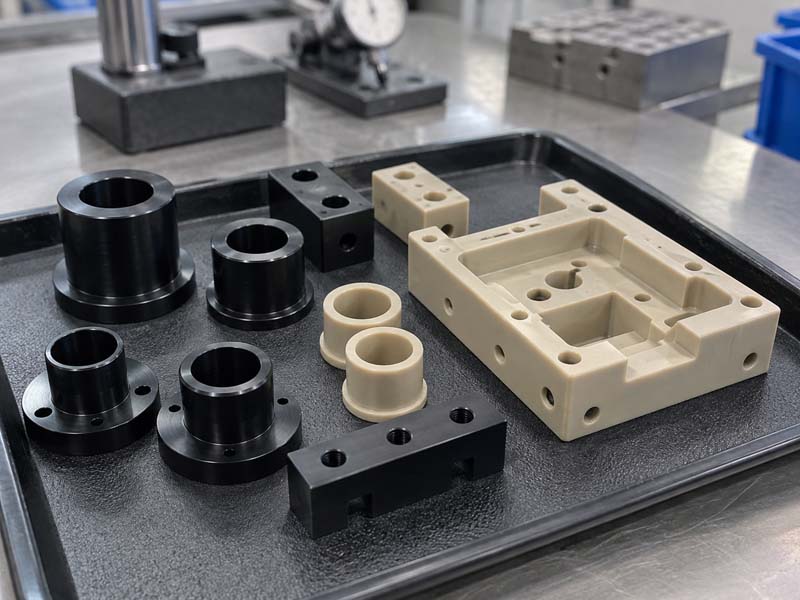
Plastics are increasingly used in CNC machining for their light weight, chemical resistance, electrical insulation, and low friction. Common options include Nylon (PA), Delrin (POM), PTFE, and ABS.
Nylon (PA6/PA66)
Nylon offers good strength, toughness, and wear resistance. It absorbs moisture, which can affect dimensional stability. It is used for gears, bushings, and structural prototypes.
Delrin (POM)
Delrin has low friction, high stiffness, and excellent machinability. It is ideal for parts requiring tight tolerances and low moisture absorption, such as pulleys, bearings, and electrical insulators.
PTFE (Teflon)
PTFE has exceptional chemical resistance and low friction but is soft and difficult to machine to tight tolerances. It is used for seals, gaskets, and corrosive fluid handling.
Machining Plastics
Plastics require sharp tools, moderate speeds, and good chip evacuation to prevent melting. Coolant may be used, but some plastics absorb coolant. Dimensional changes due to thermal expansion must be accounted for.
Titanium and Other Exotic Alloys
Titanium (Grades 2, 5) is used in aerospace and medical implants for its high strength-to-weight ratio and biocompatibility. It is extremely difficult to machine due to low thermal conductivity and high chemical reactivity. Only experienced CNC shops with rigid machines and specialized tooling can handle titanium effectively. Lead times and costs are significantly higher.
Key Factors in Material Selection
When choosing a material for CNC machining, consider the following:
- Mechanical properties: Strength, hardness, elasticity, fatigue resistance.
- Physical properties: Density, thermal expansion, electrical conductivity.
- Environmental resistance: Corrosion, UV, chemical exposure.
- Machinability: How easily the material can be cut, surface finish achievable, tool wear.
- Cost: Raw material price plus machining cost (harder materials take longer).
- Availability: Standard stock sizes and lead times.
- Post-processing: Anodizing, plating, painting, or heat treatment requirements.
Conclusion
Understanding material properties is essential to successful CNC machining. Aluminum provides the best balance of machinability and performance for most projects. Stainless steel and brass excel in corrosion resistance and aesthetics. Engineering plastics offer unique advantages for lightweight and low-friction applications. Always consult with your CNC machining partner like Hongke CNC to validate your material choice based on your specific design and production needs. Their experienced engineers can provide DFM feedback and recommend the most cost-effective material for your part.
By carefully aligning material selection with functional requirements and manufacturing constraints, you can achieve optimal part quality, faster turnaround, and lower overall project cost.