
Quick Answer
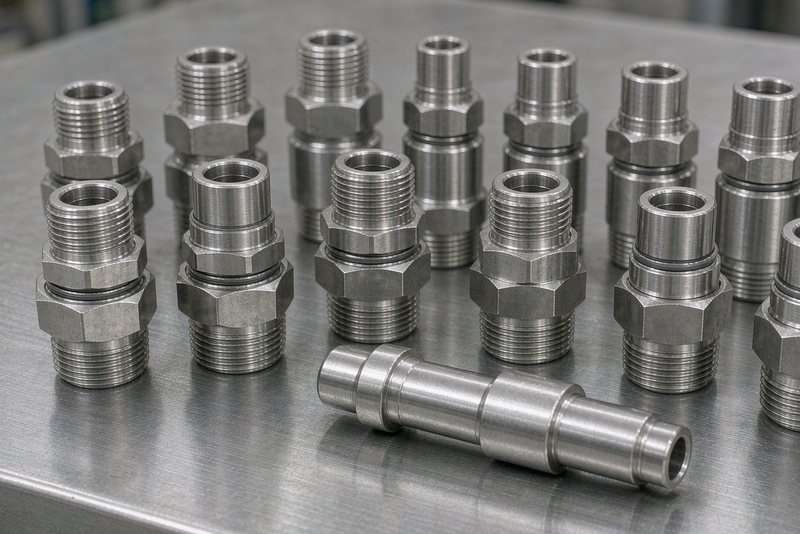
Electroless nickel plating builds a nickel-phosphorus alloy on a machined part by chemical reduction, not by passing current through it. Thickness is therefore a function of tank time, so bores, blind holes, thread flanks and outer faces receive close to the same deposit. Three decisions shape the specification: phosphorus content, deposit thickness, and whether a post-plate bake is required — and masking decides what stays bare.
Key Takeaways
- The deposit is a nickel-phosphorus alloy; the phosphorus level, usually 3% to 13%, steers hardness and corrosion resistance.
- Coverage is geometry-driven, so internal surfaces coat at nearly the same rate as external ones.
- Every wetted face grows by the deposit: 10 µm adds about 20 µm to a diameter and removes it from a bore.
- High-strength steels generally need an embrittlement relief bake inside a window the drawing sets.
- Thread allowance, sealing faces and contact pads are settled at masking, not after plating.
What Electroless Nickel Actually Deposits
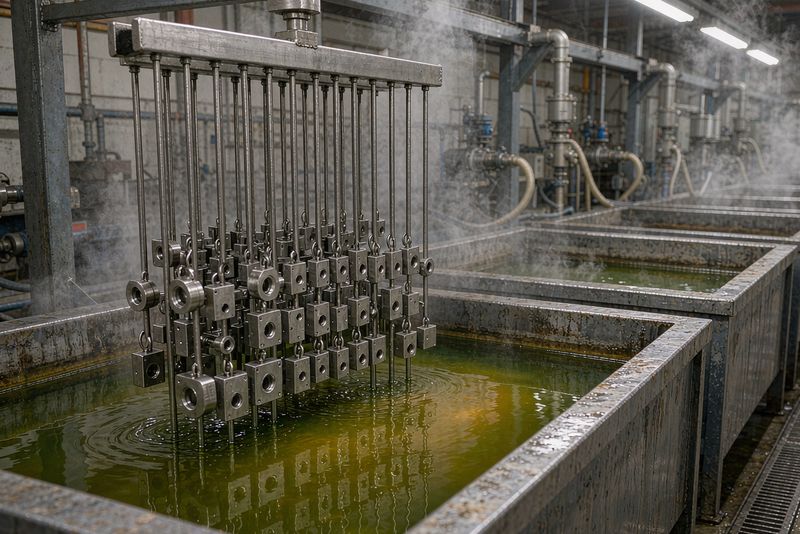
The bath holds nickel ions and a reducing agent, usually sodium hypophosphite. Once the surface is catalytically active, nickel reduces onto it and the deposit sustains the reaction — hence autocatalytic. What forms is not pure nickel: phosphorus co-deposits at 3% to 13%, and that alloy is what the drawing buys.
No current flows through the part, so there is no current-density map to fight. Bores, blind holes and thread flanks see the same chemistry as the outside, and thickness stays even where electroplating would starve. Production baths typically deposit 10 to 25 µm per hour. Long internal passages in hydraulic bodies coat as readily as an external face.
The coating also follows the substrate rather than filling it, so tool marks stay visible underneath. Settle appearance at the as-machined stage; the surface finishes guide maps Ra values to processes upstream of coating.
Phosphorus Classes and What They Change
Three families are quoted in practice. Low-phosphorus deposits, roughly 1% to 4%, are harder as plated and suit wear surfaces, at the cost of corrosion protection. Mid-phosphorus, about 5% to 9%, is the general-purpose choice for most industrial parts. High-phosphorus, 10% to 13%, is amorphous as deposited and gives the strongest corrosion resistance, which is why it suits aluminum and chemically aggressive service.
Heat treatment shifts the picture. A bake near 400 °C for about an hour can lift hardness into the high-hundreds of Vickers, at the cost of some corrosion resistance and, on aluminum, of substrate temper.
Phosphorus also shifts magnetic behavior, which matters on sensor housings, and a drawing that says only "nickel plate" leaves the class to the coater.
Thickness Arithmetic: Threads, Bores, and Mating Faces
A coating grows on every wetted face, so the dimensional effect doubles on diameters. A 10 µm deposit turns a Ø20.000 mm shaft into roughly Ø20.020 mm and a Ø20.000 mm bore into Ø19.980 mm — enough to consume a fine clearance fit and to shift a thread's fit class with no machining error.
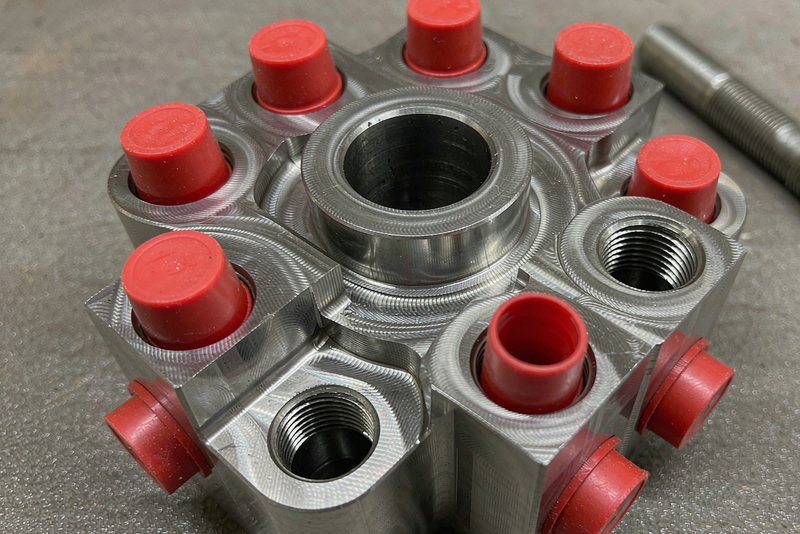
Threads deserve their own line in the RFQ. On small fine threads the allowance is short, and coating both flanks can make a gauge-tight part unusable. The options are to mask the thread, to machine it undersize before plating, or to accept the shift knowingly. The thread design guide is the place to fix the pre-plate size.
Blind holes and internal passages need a vent and a drain path. Chemistry trapped in a closed cavity bleeds out later and stains or blisters the deposit.
Adhesion, Bake, and Hydrogen Embrittlement
Adhesion is decided in pretreatment, not in the plating tank. Alkaline cleaning, acid activation and, on aluminum, a zincate cycle prepare the surface the deposit bonds to; stainless grades usually need an activation strike. Oil, oxide or a poorly rinsed surface shows up later as blistering. A burr that enters the tank comes out coated and harder to remove, so deburring runs ahead of finishing.
High-strength steels carry a hydrogen risk plating cannot design away. Parts above roughly 1000 MPa tensile normally get an embrittlement relief bake within a defined window after plating, at about 190 °C to 220 °C for several hours; the window belongs to the governing specification or a drawing note. Aluminum imposes the opposite constraint, since bakes must stay below what the temper survives. Adhesion is checked on coupons plated with the batch, not on finished parts.
Specifying Electroless Nickel Plating on a Drawing
A workable callout names the process, the governing specification for autocatalytic nickel-phosphorus, a thickness range, the phosphorus class, any post-plate heat treatment, and the areas to mask. "Nickel plate, 0.0005 inch" leaves class, bake and masking to the shop.
- State thickness as a range, for example 8 to 12 µm, and say whether it is measured on a coupon or on the part.
- List masked features: threads, dowel holes, sealing faces, grounding pads.
- Call out the bake for high-strength steel, with the window measured from the end of plating.
Two mistakes recur. One is expecting the coating to hide a rough as-machined surface; it will not. The other is comparing electroless nickel with black oxide or passivation on price alone: black oxide is a thin conversion coating for mild protection, passivation restores stainless corrosion resistance without adding thickness, and electroless nickel adds a hard layer that changes dimensions.
FAQ
Does electroless nickel plating change part dimensions?
Yes, by roughly twice the nominal thickness on any diameter. A 10 µm deposit adds about 20 µm to a shaft and removes the same from a bore, so fits belong in the drawing, not in the rework queue.
Can plated threads still assemble?
They can, if the allowance was planned. Masking the thread or machining it undersize keeps the finished thread inside its class; coating at nominal size and hoping the nut clears is where trouble starts.
How thick is electroless nickel usually called out?
For corrosion and wear protection, 8 to 25 µm covers most industrial work, with tighter ranges where a fit is involved. Thicker deposits build more at edges and cost more in tank time.