
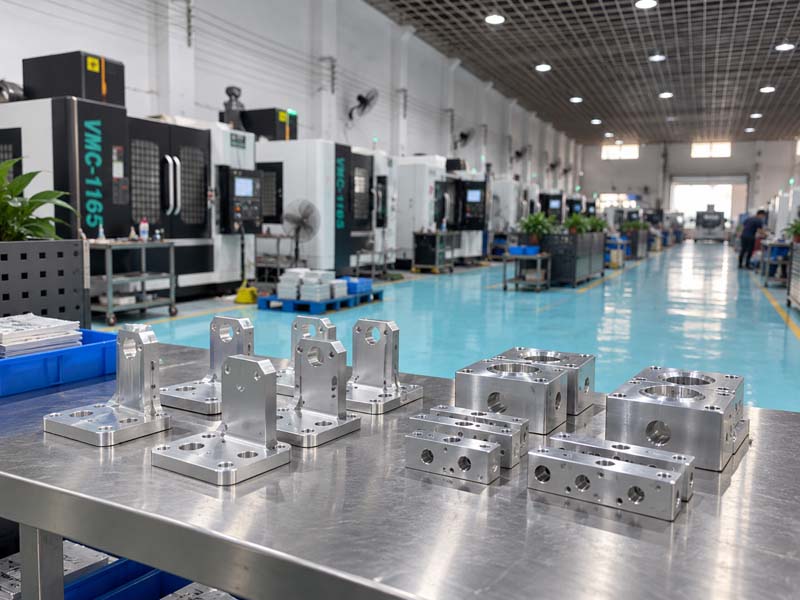
If you have worked with custom machined parts for more than a few years, you already know that the same part can cost dramatically different amounts at different suppliers. Understanding why that happens—and which factors are within your control—is the key to reducing CNC machining cost without compromising function or quality.
Every machined part begins with a design and a drawing. The decisions you make during the design phase have a far larger impact on cost than anything the machine shop does later. Tight tolerances, complex internal features, and hard-to-reach areas can increase machining time, require special tooling, and sometimes demand additional setups. Each of these adds cost. The good news is that with a clear understanding of how a part is manufactured, you can often eliminate unnecessary cost drivers while preserving all the performance requirements.
What Actually Drives CNC Machining Cost?
Before optimizing, you need to know where the cost comes from. In a typical CNC machining job, the total cost consists of several components:
- Material cost – raw stock size, material grade, and any special procurement requirements
- Setup cost – machine preparation, fixture design, tool selection, and program verification
- Machining time – time spent actually cutting material, which depends on part complexity, tool paths, and material removal volume
- Tooling cost – standard tools (included) vs. special tools (custom form tools, long reach cutters, etc.)
- Inspection cost – dimensional verification, especially for tight tolerances or complex GD&T
- Secondary operations – deburring, surface finishing, heat treatment, assembly
Among these, machining time and setup cost are the two largest and most variable. Anything that reduces the number of setups or the cycle time directly lowers the part price.
Design Choices That Reduce Machining Cost
1. Simplify Geometry Where Possible
Complex 3D contours, deep pockets, and thin walls often require multiple setups or specialized tools. If you can design a part that can be machined in two setups instead of four, you cut setup time, fixture cost, and potential error sources. Consider replacing sculpted surfaces with simple prismatic features when the function allows.
Internal corners are a classic example. A sharp square corner in a pocket must be created using a small diameter end mill, which removes material slowly and may leave a corner radius anyway. Specifying a larger internal radius allows a larger tool, faster material removal, and better surface finish. A good rule of thumb is to make internal corner radii at least 1/3 of the pocket depth, or larger if possible.
2. Avoid Unnecessarily Tight Tolerances
Many drawings specify tolerances of ±0.05 mm (or tighter) on every dimension, even those that do not affect fit or function. Tighter tolerances increase machining time, require careful workholding, demand more frequent tool changes, and often require CMM inspection. If a dimension only needs ±0.2 mm, specify ±0.2 mm. Let the supplier know which dimensions are critical and which are reference. This is the single most effective cost reduction method.
3. Reduce the Number of Setups
Each time a part must be moved to a different machine or repositioned in the same machine, it adds time and introduces potential alignment errors. Can your part be fully machined in one orientation? If not, consider adding datums or mounting features that allow the part to be located consistently across operations. 5-axis machining can often reduce multiple 3-axis setups to one or two, but it comes with higher hourly rates. For medium complexity parts, the setup reduction often more than compensates for the higher machine rate.
4. Optimize Wall Thickness and Feature Depth
Thin walls (<0.5 mm in aluminum, <1.0 mm in steel) are prone to vibration and deflection, requiring slower feeds and lighter cuts. If your design allows, increase wall thickness to improve rigidity. Similarly, deep pockets (depth more than 4 times the cutter diameter) require long reach tools that are more expensive, deflect more, and cut slower. Reducing pocket depth or stepping them in increments can significantly reduce machine time.
Material Selection for Cost Efficiency
Material cost is not just about the raw stock price. Machinability—how easily a material can be cut—affects tool life, cutting speed, and surface finish requirements. For example:
- Aluminum 6061 is easy to machine, allows high cutting speeds, and produces good surface finish with standard tools. It is the most cost-effective metal for prototype and low-volume parts.
- Stainless steel 304/316 work hardens and generates more heat, requiring slower speeds and more frequent tool changes. It can cost 2-3 times more per part than an equivalent aluminum part.
- Brass and copper are free-machining but may require chip management due to long stringy chips.
- Engineering plastics (e.g., Delrin, Nylon) are soft, fast to machine, and can be made with low tool wear, but may require specialized tool geometries to avoid melting.
If your part can function in a more machinable material, that choice has a direct and large effect on cost. Discuss material options with your supplier early.
How Quantity Affects Unit Price
Setup cost is a fixed expense per order. If you order 1 piece, the setup cost is allocated to that single part. If you order 100 pieces, it spreads across the batch. As quantities increase, you can often justify dedicated fixtures, automated workholding, and custom tools that bring unit cost down. For low-volume runs (1-50 parts), designing for minimal setup is essential. For higher volumes (500+ parts), consider features that allow gang machining or multi-part fixtures.
Supplier Communication and Drawing Preparation
A clear, complete drawing helps the supplier provide an accurate quotation and avoid costly mistakes. Include:
- Complete 3D CAD file (STEP or IGES) and a 2D PDF drawing with tolerances
- Material grade, hardness, and any heat treatment requirements
- Surface finish specification (Ra value or equivalent)
- Critical dimensions clearly marked (preferably with GD&T datums)
- Quantity, packaging, and delivery requirements
When you send a well-prepared RFQ, the supplier can quickly assess feasibility and identify cost reduction opportunities. Many experienced machining shops offer DFM feedback that can save 20-40% on the original design without affecting performance.
Realistic Cost-Saving Actions You Can Take
| Action | Potential Cost Reduction | Implementation Effort |
|---|---|---|
| Loosen non-critical tolerances from ±0.05 to ±0.2 mm | 15-25% | Low (drawing change) |
| Increase internal corner radii from 1 mm to 3 mm | 10-20% machining time | Low (design change) |
| Reduce part complexity or combine features | 20-40% | Medium (redesign) |
| Change from 304 stainless to 6061 aluminum | 30-50% material + machining | Medium if function allows |
| Order double the quantity for same setup | 15-30% per piece | Planning change |
Common Mistakes That Increase Cost Unnecessarily
- Specifying a surface finish of Ra 0.4 μm on all surfaces when only certain sealing or sliding surfaces need it. Fine finishes require extra polishing passes.
- Requiring all dimensions to be inspected – let the supplier know which dimensions are critical and which can be skip-inspected.
- Adding threads in deep, small holes that require special tap extensions and risk tool breakage.
- Designing undercuts that force additional operations (e.g., T-slots, O-ring grooves) without understanding how they are cut.
When Should You Consider Multi-Axis Machining?
3-axis machining is the workhorse for prismatic parts and is generally the lowest cost per hour. However, parts with complex 3D surfaces, angled features, or needing access from multiple sides may be better suited to 5-axis machining. The key is to compare total cost: a 5-axis machine may cost $120 per hour vs. $80 for a 3-axis machine, but if it reduces five setups to one and eliminates a fixture, the overall job cost can be lower. Always evaluate per-part cost, not hourly rate.
Work with an Experienced Machining Partner
Reducing CNC machining cost is a collaborative effort between the design engineer, the procurement team, and the machine shop. An experienced partner will review your drawing before quoting, point out costly features, and suggest practical alternatives. They understand the interplay between tolerance, geometry, material, and toolpath. At Hongke CNC, our engineering team routinely helps customers optimize parts for manufacturability, often reducing total cost while maintaining or improving quality.
If you are preparing a new project or re-evaluating an existing part, take the time to review your drawing with a fresh eye. The small additions you avoid—tight tolerances, sharp corners, deep pockets—can translate into meaningful savings over thousands of parts.
For a detailed review of your part design and a competitive quotation, contact our engineering team. We provide free DFM analysis for custom machined parts.