Quick Answer
The short answer to unilateral vs bilateral tolerance is that the decision is about direction, not width. A bilateral tolerance splits the allowance evenly around the nominal size, so the shop works in both directions from the printed number. A unilateral tolerance puts the whole allowance on one side, which signals that only one direction of error matters to the function — and that the cutting target has moved. Both calls are valid; the mistake is choosing one out of habit rather than from the assembly requirement.
Key Takeaways
- A bilateral tolerance is symmetric: ±0.05 mm on a 12 mm shaft permits 11.95 to 12.05 mm, with the nominal in the middle.
- A unilateral tolerance is one-sided: a 12 mm bore written +0.05/-0.00 permits 12.00 to 12.05 mm, with the nominal at the edge.
- The same printed value means different things: ±0.05 permits a 0.10 mm spread while +0.05/-0.00 permits only 0.05 mm.
- Direction should follow the assembly, and one-sided windows shift the target, so they usually cost more to hold and inspect.
What Unilateral and Bilateral Tolerance Actually Describe
Every dimensional tolerance has a width and a direction, and most discussions cover only the width — yet the direction decides where the machinist aims.
A bilateral tolerance is symmetric. The nominal size sits in the middle of the permitted range and the allowance is split evenly above and below it, so ±0.05 mm on a 12 mm shaft permits 11.95 to 12.05 mm.
A unilateral tolerance is one-sided. The nominal sits on one edge of the range, so a bore written 12 +0.05/-0.00 permits 12.00 to 12.05 mm. The label still reads 12, but the centre of the working window is 12.025 mm.
Why Unilateral vs Bilateral Tolerance Is a Functional Choice
The assembly tells you which side of the window carries the risk, and that is what should drive the callout.
Where a pin or bolt has to pass through a hole by hand, a slightly large hole is harmless and a slightly small one blocks assembly, so the hole is written with the allowance above nominal. On a retained joint the logic flips: a bore that is too large loses grip, so the allowance goes below nominal.
Bilateral callouts make sense when error hurts in both directions, such as a sealing face that must neither open nor crush. Otherwise, a symmetric callout spends half the allowance on a direction nobody is checking.
Typical practice is to put the whole allowance on the side that matters. An exception is a purchased component whose catalogue already defines the tolerance; the drawing then adopts the supplier's window. How those limits interact with the mating part is covered in hole tolerances and fits for CNC machined parts.
What a One-Sided Limit Changes on the Shop Floor
The printed nominal stops being the target. On a +0.05/-0.00 bore, cutting to 12.000 mm leaves the whole allowance on one side, so any drift below nominal is out of specification.
Typical practice is to set the tool offset to the centre of the permitted window — 12.025 mm in that example — so variation has somewhere to go in both directions. That centre is rarely a round number, so the offset has to be calculated rather than dialled in from the drawing label.
Tool wear adds a second constraint: a boring bar or reamer changes size as it wears, so the shop has to choose which end of the window to start from.
Where One-Sided Limits Cost More to Hold
The costliest misconception about tolerance direction is that it is free.
A ±0.05 mm callout permits a total spread of 0.10 mm. Write the same value as +0.05/-0.00 and the permitted spread drops to 0.05 mm. The number on the drawing did not change, but the requirement became roughly twice as tight, because all the variation now has to fit on one side of the nominal.
That reduced window shows up as more frequent in-process checks, a process that has to be centred rather than merely capable, and a higher scrap risk when material or machine conditions drift. Where the width genuinely has to be small, the honest trade is usually to widen the one-sided window.
Inspection is the second cost. A one-sided bore often cannot be checked with a symmetric plug gauge, so the plan needs a range of gauge sizes or a variable measurement tied to a documented target; how to prepare a 2D drawing for CNC machining covers how to present both.
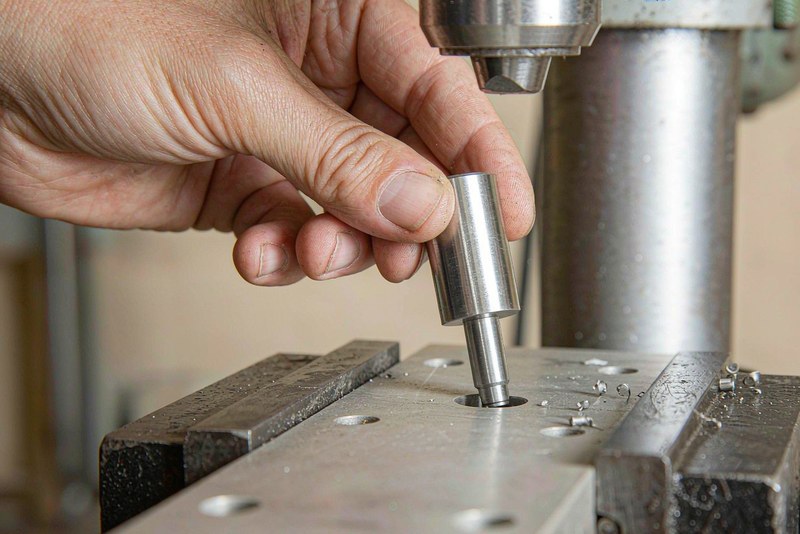
Asymmetric Tolerances in Stack-Up and Inspection
Asymmetric callouts such as +0.02/-0.03 describe a window that is not centred, and they break a common shortcut.
In a worst-case stack, the mean of each contributor is no longer the nominal size, so arithmetic that assumes a symmetric ± understates one side of the chain. Convert each callout to its upper and lower limits first, then add the limits separately. Statistical methods assume each process is centred in its window, which is weaker when a callout is lopsided; both are set out in tolerance stack-up analysis for CNC parts.
Inspection follows the same logic. A go/no-go gauge answers only whether the part is inside the window; a variable measurement answers where inside it the part sits, which matters more on a one-sided window.
Treating unilateral vs bilateral tolerance as a cosmetic difference is where stack-ups and gauge plans go wrong.
FAQ
Does a unilateral tolerance mean the part must be machined to the nominal size?
No. The nominal sits at the edge of the window; typical practice is to target the middle of the permitted range instead.
Is a limit dimension the same thing as a unilateral tolerance?
They describe the same window differently. Limit dimensioning states the two permitted sizes directly, which is often clearer when the two sides have different requirements.
Can a general tolerance block cover one-sided features?
A general tolerance block is normally symmetric, so it suits features whose direction does not matter; where direction matters, call the limit out on the feature.