
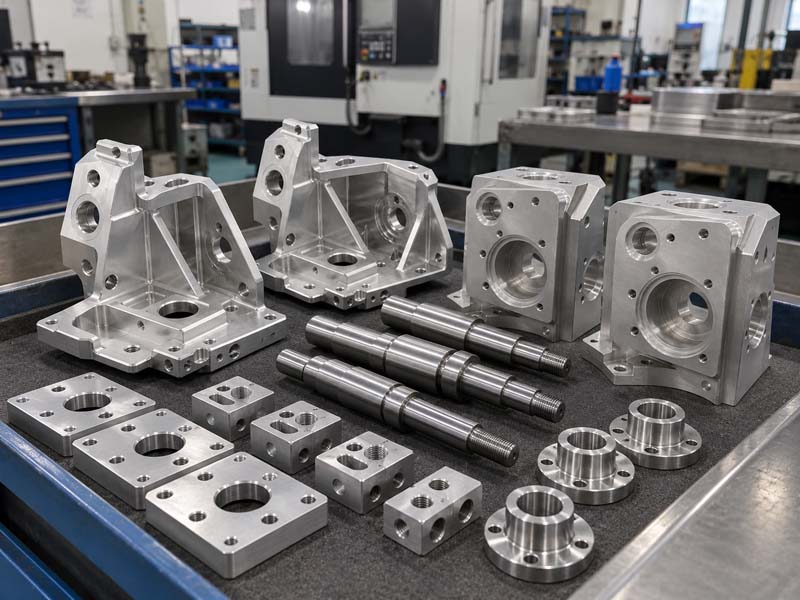
CNC Machining Services – Precision Custom Machined Parts
When you need a part machined to tight tolerances, from a specific material, and delivered on a predictable schedule, you are not just buying machine time. You are buying engineering judgment, process planning, and quality control. A reliable CNC machining service should be able to evaluate your part geometry, recommend the most efficient process—whether that is 3-axis machining, 4-axis machining, or 5-axis CNC machining—and produce consistent results across a single prototype or a low-volume production run.
This guide covers what you should expect from a precision CNC machining partner, how different machining processes affect part quality and cost, and what information helps suppliers give you an accurate CNC machining quote. Whether you are an engineer reviewing a drawing or a machined parts purchaser evaluating a new supplier, understanding these fundamentals will help you make better decisions.
What Are CNC Machining Services?
CNC machining services refer to the use of computer-controlled machine tools to remove material from a workpiece and produce a finished part to specified dimensions. The process is subtractive: you start with a block, bar, or billet of metal or plastic, and the CNC machine cuts away excess material until only the desired geometry remains.
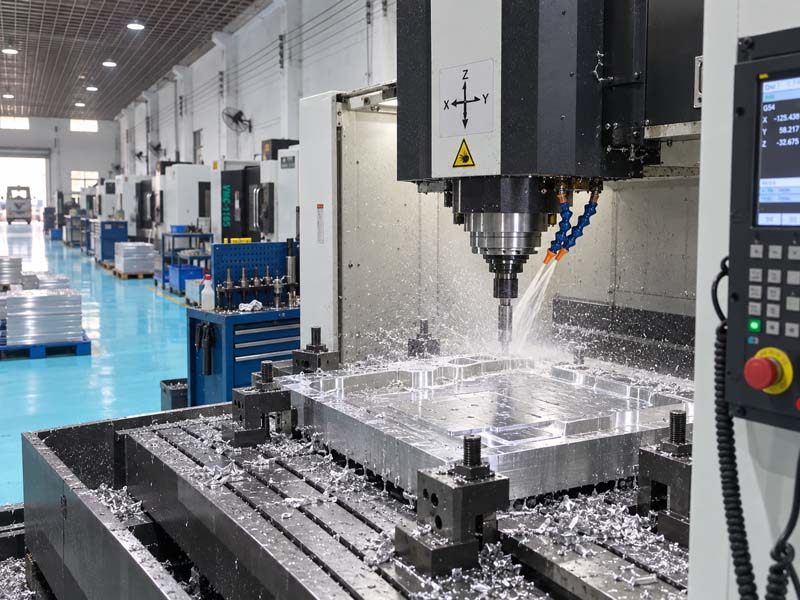
A professional custom CNC machining shop typically offers a range of capabilities to handle different part shapes, sizes, and complexity levels:
- CNC milling – Uses rotating cutting tools to remove material from a stationary workpiece. Ideal for flat surfaces, pockets, slots, and complex 3D contours.
- CNC turning – Rotates the workpiece against a stationary cutting tool. Best for cylindrical parts, shafts, bushings, and threaded components.
- Multi-axis machining – 3-axis, 4-axis, and 5-axis machines allow the tool or workpiece to move along additional axes, reducing setups and enabling complex geometries.
- Drilling, tapping, reaming, and boring – Precision hole-making operations that are often performed on the same CNC machine in a single setup.
Many shops also provide value-added services such as surface finishing (anodizing, powder coating, plating), assembly, and quality inspection (CMM, gauges).
Key Machining Capabilities to Look For
CNC Milling Services
CNC milling services are the backbone of most precision machining shops. A CNC mill uses a rotating cutter that moves across multiple axes to shape the part. Common applications include brackets, housings, enclosures, manifolds, and structural components.
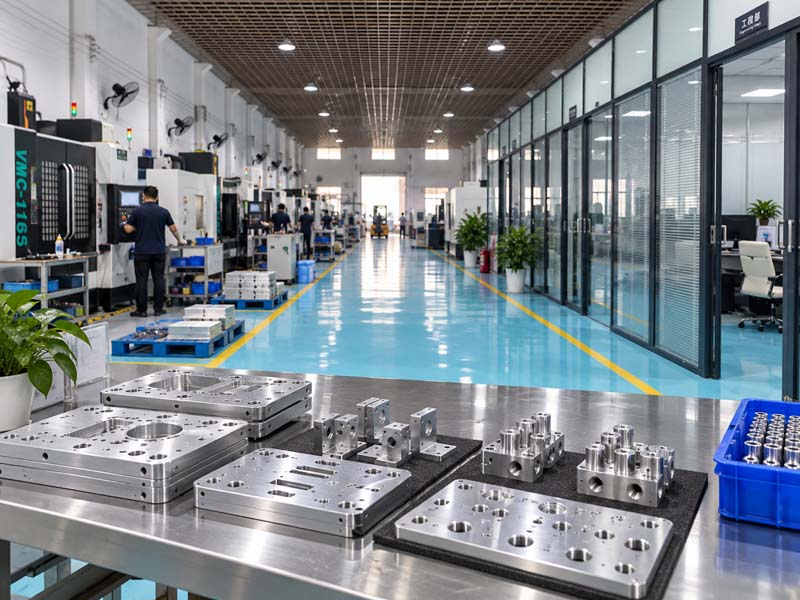
- 3-axis milling – The workpiece remains stationary while the cutter moves in X, Y, and Z. Suitable for prismatic parts with flat surfaces, pockets, and holes.
- 4-axis milling – Adds rotation around the X-axis (called the A-axis). Allows machining on multiple sides of the part without manual repositioning.
- 5-axis CNC machining – The cutter or workpiece can tilt and rotate along two additional axes. This reduces the number of setups required and allows complex geometries like impellers, turbine blades, and contoured surfaces to be machined in a single fixturing.
For a custom CNC machining project, the choice between 3-axis and 5-axis depends on part complexity, tolerance requirements, and budget. A simple bracket might be perfectly suited for 3-axis, while a complex manifold with angled ports may require 5-axis to avoid multiple setups and reduce tolerance stack.
CNC Turning Services
CNC turning services are used for cylindrical parts. The workpiece rotates while a cutting tool moves along its length to remove material. A CNC lathe can produce shafts, pins, bushings, sleeves, and threaded fittings with excellent concentricity and surface finish.
Modern turning centers often include live tooling (milling capability on a lathe), allowing complex parts to be completed in a single machine. This is particularly valuable for parts that require both turned diameters and milled features like flats, cross-holes, or keyways.
The Custom CNC Machining Process
Step 1: Design Review and DFM
Before any cutting begins, the engineering team reviews the customer's 3D CAD model (STEP, STP, IGES) and 2D drawing. This is where Design for Manufacturability (DFM) feedback comes in. An experienced shop will identify potential issues such as:
- Thin walls that may deform during machining
- Deep pockets requiring long tools that can deflect
- Internal sharp corners that cannot be achieved with standard radius tools
- Unnecessarily tight tolerances that increase cost without functional benefit
- Missing datum references or conflicting dimensions
A good DFM review helps you optimize your design before production, saving time and reducing the risk of scrap.
Step 2: Process Planning and Programming
Based on the part geometry and material, the team selects the appropriate CNC machining process—milling, turning, or a combination. They determine the number of setups, fixture design, tool selection, cutting speeds and feeds, and the sequence of operations.
For complex parts, 5-axis CNC machining may be chosen to minimize setups and improve accuracy. For high-volume runs, the focus shifts to cycle time optimization and tool life management.
Step 3: Machining and Inspection
Once the program is loaded, the CNC machine produces the first part. This initial piece is carefully inspected using:
- CMM (Coordinate Measuring Machine)
- Height gauges
- Micrometers and calipers
- Surface roughness testers
- Thread gauges
Any deviations are noted, and the program or setup is adjusted before production continues. A robust quality inspection process ensures that every part meets the specified machining tolerance and surface roughness requirements.
Materials Commonly Used in CNC Machining
A versatile CNC machining manufacturer can work with a wide range of materials. The choice depends on the part's application, mechanical requirements, and environmental conditions.
- Aluminum (6061, 7075, 2024) – Excellent machinability, light weight, good strength. Widely used in aerospace, automotive, and electronics.
- Stainless steel (303, 304, 316) – Corrosion resistant, higher strength. Suitable for medical, food processing, and marine applications.
- Carbon steel and alloy steel (1018, 4140, 4340) – Good strength and wear resistance. Common for shafts, gears, and structural components.
- Brass and copper – Easy to machine, excellent electrical conductivity. Used in fittings, terminals, and valves.
- Titanium – High strength-to-weight ratio, but more difficult to machine. Used in aerospace and medical implants.
- Engineering plastics (Delrin, Nylon, PEEK, PTFE) – Lightweight, chemical resistant, low friction. Ideal for bushings, insulators, and custom fixtures.
Each material behaves differently during CNC machining. Aluminum generates less tool wear but can produce burrs. Stainless steel work-hardens, requiring sharp tools and consistent feeds. Plastics can melt if speeds are too high. An experienced precision machining team adjusts parameters accordingly.
Tolerances and Surface Finishes
What Tolerance Can CNC Machining Achieve?
As a general engineering reference, CNC machining is capable of holding tolerances in the range of ±0.005 inches (±0.13 mm) for standard dimensions. With tighter control, ±0.002 inches (±0.05 mm) or even ±0.001 inches (±0.025 mm) can be achieved on critical features. However, the achievable tolerance depends on several factors:
- Part geometry – Long, thin walls are more difficult to hold to tight tolerances than compact, rigid shapes.
- Material – Harder materials like tool steel or titanium can cause more tool deflection, affecting accuracy.
- Number of setups – Each time a part is repositioned, tolerance stack can occur.
- Machine condition – Well-maintained machines with thermal compensation produce more consistent parts.
It is important not to over-specify tolerances. Adding a tight tolerance to a dimension that is not functionally critical increases CNC machining cost without benefit. A good supplier will help you identify which dimensions truly require tight control.
Surface Roughness
Surface finish is specified as Ra (average roughness). Typical values for CNC machining range from Ra 3.2 μm (standard machining) down to Ra 0.4 μm (fine finish with special tooling and passes). The required surface finish affects tool path, stepover, and cycle time.
| Ra Value | Typical Application |
|---|---|
| 3.2 μm (125 μin) | General machining, non-critical surfaces |
| 1.6 μm (63 μin) | Bearing surfaces, sliding fits |
| 0.8 μm (32 μin) | Precision components, sealing surfaces |
| 0.4 μm (16 μin) | High-precision, optical or medical parts |
If a smoother finish is required, secondary processes like grinding, polishing, or lapping may be necessary.
Factors Affecting CNC Machining Cost
Understanding what drives CNC machining price helps you design parts for lower cost without sacrificing quality. The major factors include:
- Material cost – Raw material prices vary widely. Aluminum is generally affordable; titanium and certain plastics are more expensive.
- Machining time – The longer the machine is running, the higher the cost. Complex geometries with deep pockets, tight tolerances, or fine surface finishes increase cycle time.
- Setup time – Each time a part is moved to a different machine or fixture, setup time is added. 5-axis machining can reduce setups but requires more expensive equipment.
- Tooling – Special tools (long reach cutters, custom form tools, thread mills) add cost. Standard tooling is more economical.
- Quantity – Prototype quantities (1–10 pieces) are more expensive per part. As quantity increases, the per-part cost decreases due to amortized setup and programming.
- Tight tolerances – Tighter tolerances require slower feeds, more frequent tool changes, and more rigorous inspection, all of which add cost.
- Surface finishing – Anodizing, plating, powder coating, and other finishes add cost and lead time.
For a CNC machining quotation, provide as much information as possible: complete 3D model, 2D drawing with tolerances, material specification, quantity, and required surface finish. This allows the supplier to give an accurate and competitive quote.
How to Choose the Right CNC Machining Supplier
Selecting a CNC machining manufacturer or precision machining supplier is a critical decision for project success. Here are key evaluation criteria:
- Capability matching – Does the shop have the right machines (3-axis, 4-axis, 5-axis, turning centers) for your part? Do they offer the specific CNC milling services or CNC turning services you need?
- Material experience – Have they machined your specified material before? Different materials require different tooling and parameters.
- Engineering review – Do they offer DFM feedback? A good shop will proactively suggest design improvements.
- Quality control – What inspection equipment do they use (CMM, optical comparators)? Do they provide inspection reports?
- Communication – Are they responsive? Do they ask clarifying questions during quoting? This indicates engineering involvement.
- Lead times – Can they meet your schedule? For prototype work, fast turnaround is often critical.
A custom CNC parts supplier who demonstrates engineering depth and clear communication is more likely to deliver consistent quality.
Common Applications of Precision CNC Machining
Precision machined parts are used across virtually every industry. Common examples include:
- Industrial equipment – Pump housings, valve bodies, manifolds, brackets, and frames
- Automation and robotics – Fixtures, jigs, grippers, and structural components
- Medical devices – Surgical instruments, implant prototypes, and diagnostic equipment parts
- Aerospace – Bracket assemblies, engine components, and structural brackets (subject to strict certifications)
- Electronics – Enclosures, heat sinks, and connector housings
- Oil and gas – Fittings, connectors, and valve components
The versatility of CNC machining makes it suitable for both one-off prototypes and low-to-medium volume production runs.
Getting a CNC Machining Quote
To obtain an accurate CNC machining quote, prepare the following information:
- 3D CAD file – STEP or IGES format is preferred. STL files are less ideal because they lack surface continuity.
- 2D drawing – Include critical dimensions, tolerances, GD&T callouts, and surface finish requirements.
- Material – Specify grade (e.g., 6061-T6 aluminum, 304 stainless steel).
- Quantity – Prototype, small batch, or production run.
- Surface finish – As-machined, anodized, plated, etc.
- Special requirements – Threaded inserts, marking, assembly, or certification.
A reputable CNC machining service provider will review your files, ask clarifying questions if needed, and provide a detailed quote with breakdown of material, machining, and finishing costs.
Conclusion
Choosing the right CNC machining services is about more than just price. It is about finding a precision CNC machining partner with the technical expertise to review your design, the equipment to handle your part geometry, and the quality processes to deliver consistent results. By understanding the capabilities of different machining processes, the impact of material selection, and the factors that drive cost, you can make informed decisions for your custom machined parts projects. If you have a design ready, the next step is to submit your 3D CAD model and 2D drawing for professional review and a competitive CNC machining quote.