
Quick Answer
Passivation vs electropolishing comes down to what each process changes. Passivation strips free iron and contamination without altering geometry. Electropolishing also cleans the surface, but removes a small, controlled layer of metal, so it lowers Ra and shifts dimensions on tight features. Specify passivation when corrosion resistance is the goal and the machined surface already meets the drawing; specify electropolishing when the surface itself has to be smoother and cleaner.
Key Takeaways
- Passivation removes contamination, not metal, so machined dimensions stay as drawn.
- Electropolishing removes a controlled layer and usually lowers Ra, so tight features need an allowance.
- Neither process rescues a poor machined surface; deep tool marks and embedded iron survive both.
- Edge condition comes first — a burr that reaches the bath comes out polished, not removed.
- Both are supplier-coordinated steps, so the sequence with machining and deburring belongs in the plan.
What Passivation and Electropolishing Actually Do
After machining, stainless steel carries smeared metal, embedded iron-rich particles and a broken passive chromium oxide film. Passivation addresses that chemistry: an acid bath — citric and nitric chemistries are the usual families — dissolves free iron and tool material and lets the passive film re-form. Base metal removal is negligible, so bores, threads and fits keep the sizes machining produced.
Electropolishing works the same intent electrochemically. The part is the anode in a temperature-controlled electrolyte, and current attacks the high points first, levelling micro-peaks. Light electropolishing is commonly quoted at 0.0002–0.0005 mm of stock removal, set by the bath and dwell time. Where Ra drives the choice, the CNC machining surface finish guide explains how those values are specified.
Passivation vs Electropolishing: How They Compare
| Question | Passivation | Electropolishing |
|---|---|---|
| Metal removed | Essentially none | Small, controlled layer |
| Effect on Ra | Little change | Usually improves |
| Dimensional risk | Low | Needs an allowance |
The two processes answer different questions. Passivation asks whether surface chemistry is clean enough for the alloy to passivate itself, while electropolishing asks whether the surface geometry is good enough and then cleans it as a side effect.
Corrosion performance follows a similar split: passivation restores the film machining disrupted, while electropolishing removes the outermost layer with the contamination in it. Where the grade is still open, 304 vs 316 stainless steel covers how each behaves after machining.
When Electropolishing Is Worth the Extra Cost
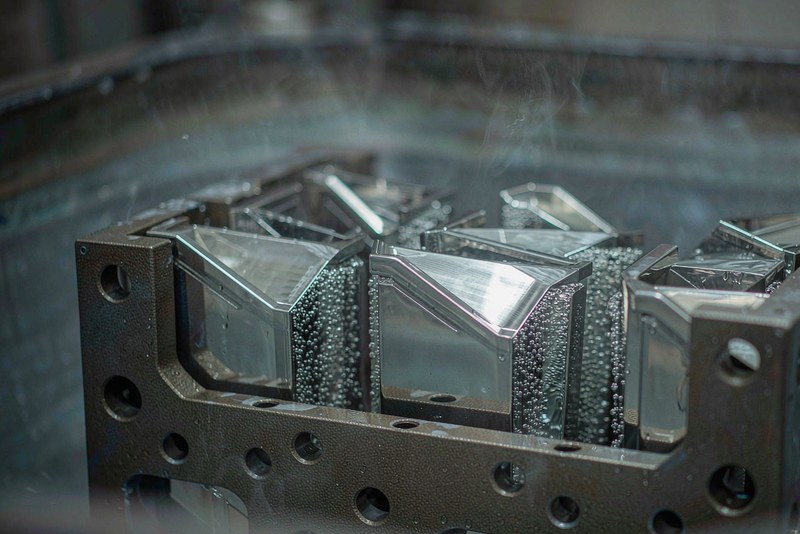
Electropolishing earns its premium when the surface has a job beyond looking acceptable: sanitary manifolds, high-vacuum hardware, gas-delivery components and parts where retained contamination is a functional risk. It also suits parts needing a texture finer than machining can hold repeatably, on selected critical features and depending on material, geometry, workholding, process route and inspection requirements.
The premium is harder to justify when corrosion resistance is the requirement and the machined surface already meets the drawing, because passivation delivers it without bath time, fixturing or a dimensional allowance.
Brightness is a by-product rather than a performance requirement, and on aluminum parts the electrochemical route does not apply; anodizing and conversion coatings are the options to compare.
Callouts, Dimensions, and Masking
A finishing callout has to answer three questions: which process, what acceptance criteria and which features are off limits. Typical practice names the process and its specification, states how inspection will verify it, and marks the surfaces to protect; the guide to preparing a 2D drawing for CNC machining covers how those notes are laid out.
Electropolishing needs one more number: the allowable stock removal. A bore, thread or sealing face sitting at the low end of its tolerance can be pushed out of tolerance by a bath that removes material from every exposed surface. The usual answers are to mask it, to machine it after finishing, or to shift the pre-finish dimension so the finished part lands inside the band.
Deburring belongs upstream of both processes, and the deburring guide for machined parts explains why a burr that reaches the bath comes out polished instead of removed.
Common Mistakes and What They Cost
The expensive mistakes cluster in the same places. Passivation after blasting with iron-bearing media drives contamination deeper than the chemistry reaches, so corrosion appears in service, not at inspection. Electropolishing on parts whose tight features sit at the low limit trades a surface improvement for a dimensional failure. Using either process as a substitute for deburring leaves sharp edges behind. Leaving Ra off the drawing means the part is accepted on appearance, which does not predict corrosion performance. Treating "bright" as the acceptance criterion makes a cosmetic variable the reason a shipment is rejected.
Most of these are caught before machining, when passivation vs electropolishing is settled against the drawing. They are expensive to catch later, when the part may not be reworkable and a bath cycle is already spent.
FAQ
Does passivation change part dimensions?
Practically no. It dissolves contamination rather than base metal, so the dimensions from the bath are the ones machining produced. Ra can still move, but far less than after electropolishing.
Can electropolishing replace deburring?
It reduces small burrs by attacking high points, but it is not an edge-conditioning process. Heavy burrs and sharp thread starts need mechanical deburring first.
Which process suits a food-processing manifold?
Electropolishing is the usual choice where cleanability and retained contamination drive the requirement, since it improves surface texture and surface chemistry together. Confirm the route against the actual service conditions.