
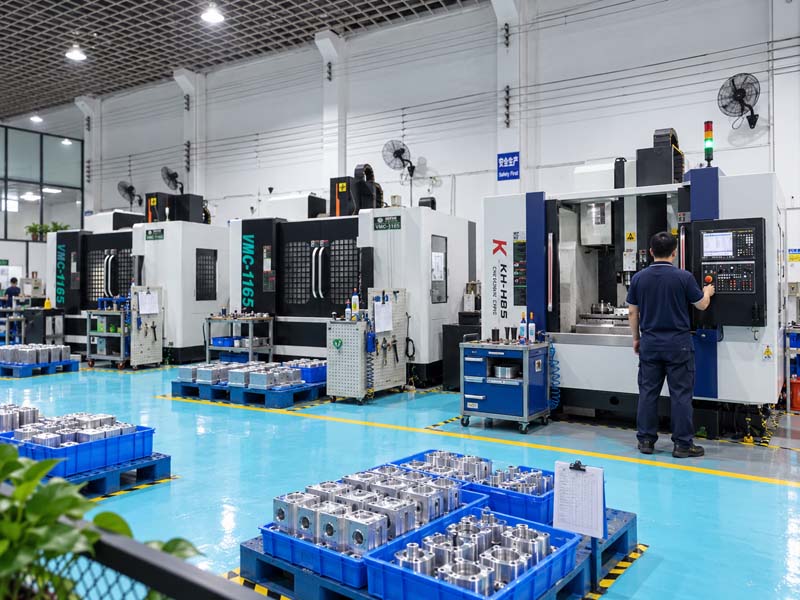
Why Spindle Bearing Selection Matters in CNC Machining
In any precision CNC machining operation, the spindle is the core rotating assembly that holds the cutting tool or workpiece. The bearing set inside the spindle directly determines how accurately and smoothly the shaft rotates under load. Among all bearing types used in machine tool spindles, angular contact ball bearings with P4 grade accuracy are the most common choice for achieving high rotational precision, stiffness, and thermal stability.
For engineers evaluating a CNC machining supplier or designing a custom machine tool, understanding how these bearings are specified, assembled, and maintained is essential. A poorly selected or incorrectly installed bearing set can introduce runout, vibration, heat buildup, and premature wear, all of which degrade part finish and dimensional accuracy.
What Is an Angular Contact Ball Bearing?
Unlike deep groove ball bearings, which are designed primarily for radial loads, angular contact ball bearings have raceways that are offset relative to the bearing axis. This geometry allows them to support combined radial and axial (thrust) loads simultaneously. The contact angle, typically 15° (C) or 25° (AC), determines the axial load capacity and stiffness.
In a CNC spindle application, these bearings are almost always mounted in a paired or matched set (back-to-back, face-to-face, or tandem arrangement) to control shaft positioning, thermal expansion, and preload. A single bearing cannot provide the bidirectional thrust capacity and rigidity that spindle operation demands.
P4 Grade Accuracy Explained
Bearing accuracy grades are defined by ISO 492 and ABEC standards. For precision spindles, P4 (equivalent to ABEC 7) is the most widely used class. Key tolerances controlled under P4 grade include:
- Inner ring bore diameter variation: typically within 4–6 µm
- Outer ring outside diameter variation: similar range depending on bearing size
- Radial runout of assembled bearing: typically within 2–4 µm
- Axial runout (face squareness): tightly controlled for consistent preload
These tolerances ensure that when the bearing is installed in a properly machined housing and on a ground shaft journal, the resulting spindle runout is minimal. For general reference, a P4 grade spindle bearing assembly can typically achieve runout below 5 µm, which is sufficient for most precision milling, grinding, and turning operations.
P4 vs. P5 and P2 Grades
For context, P5 (ABEC 5) is a common class for less demanding applications such as gearboxes or general machinery. P2 (ABEC 9) is used only in ultra-precision spindles for applications like wafer dicing or high-end grinding machines. P4 represents the practical balance between cost, availability, and performance for standard CNC machine tools.
Bearing Arrangement and Preload
How the bearings are arranged in the spindle has a direct impact on stiffness, heat generation, and allowable operating speed. Three common configurations are used:
Back-to-Back (DB) Arrangement
The larger contact angle faces outward. This setup provides high tilting stiffness and is best for handling moment loads. It is the most common arrangement for the front bearing set of a milling spindle. As the spindle heats up, the preload tends to increase slightly due to thermal expansion, which can improve rigidity at the cost of higher running temperature.
Face-to-Face (DF) Arrangement
The smaller contact angle faces inward. This arrangement is less stiff under moment loads but handles thermal expansion better. It is sometimes used for the rear bearing set or for spindles that experience significant temperature variation during operation.
Tandem (DT) Arrangement
Multiple bearings are arranged in the same direction to share axial load. This is used when a single bearing cannot provide sufficient thrust capacity. Tandem sets do not provide bidirectional axial support, so they are usually combined with another arrangement in the same spindle.
Preload Selection
Preload is the internal axial force applied to the bearing set to eliminate internal clearance. Three preload levels are common:
- Light preload (L): used for high-speed spindles where heat generation must be minimized
- Medium preload (M): the default choice for most general-purpose CNC spindles
- Heavy preload (H): used for low-speed, heavy-cutting applications requiring maximum stiffness
Selecting the correct preload is critical. Too little preload allows ball skidding and reduces rigidity. Too much preload generates excessive heat, shortens lubricant life, and can cause thermal runaway. For a typical 10,000–15,000 RPM spindle, medium preload with grease lubrication is a common starting point.
Lubrication: Grease vs. Oil-Air
The lubrication method directly affects the maximum allowable spindle speed, bearing life, and maintenance interval.
Grease Lubrication
Most standard spindles use grease lubrication because it is simple, clean, and requires no external oil system. High-performance polyurea or synthetic ester greases are formulated specifically for angular contact bearings. The grease is typically packed at 25–35% of the free space in the bearing. Grease-lubricated spindles are generally limited to a speed factor (DN value) of approximately 1,000,000 to 1,200,000.
For example, a spindle with a 70 mm bore bearing (diameter 70 mm) running at 15,000 RPM has a DN value of 70 × 15,000 = 1,050,000, which is within the grease range.
Oil-Air Lubrication
For speeds above 15,000 RPM or for spindles requiring very low heat generation, oil-air lubrication is used. A precise amount of oil is delivered as a fine mist through compressed air to the bearing contact surfaces. This reduces internal friction and allows DN values up to 1,800,000 or higher. The trade-off is the need for a lubrication control unit and more frequent maintenance.
Mounting and Preload Adjustment
Proper mounting is as important as bearing quality. The following steps are typical in spindle assembly:
- The shaft journal and housing bore must be machined to tight tolerances, typically h5 or j5 for the shaft and J5 or K5 for the housing.
- The bearing must be pressed onto the shaft using even force applied to the inner ring face. Pressing through the outer ring damages the raceway.
- For matched sets, the bearing manufacturer specifies the order and orientation. These sets are sold as pairs and should never be mixed with bearings from different sets.
- The nut or locknut is tightened to a specified torque to establish preload. Some spindles use a precision ground spacer between bearings to set preload without relying on nut torque.
After assembly, the spindle runout is measured at the tool interface. For a P4 grade assembly, a runout value of 2–4 µm at the nose is considered excellent. Values above 8 µm indicate a problem with bearing installation, shaft accuracy, or housing fit.
Common Problems and Symptoms
Vibration During Cutting
If the spindle shows increased vibration during machining, possible causes include bearing wear, incorrect preload, or contamination. Worn bearings produce a characteristic high-frequency noise. Measuring vibration acceleration on the spindle housing can identify early bearing failure.
Overheating
Excessive heat at the spindle housing indicates too much preload, inadequate lubrication, or bearing damage. Running temperature above 60°C at the housing is a warning sign. The spindle should be stopped and inspected.
Poor Surface Finish
Chatter marks or irregular surface patterns on machined parts may be caused by spindle bearing runout. A simple test is to machine a test ring and measure the roundness. If the deviation exceeds the expected tolerance band, the spindle bearings should be examined.
Bearing Life and Replacement Interval
With proper lubrication, moderate cutting loads, and clean operating conditions, P4 grade angular contact ball bearings in a CNC spindle typically last 8,000 to 20,000 operating hours. Spindles used for heavy roughing or those exposed to coolant contamination fail sooner. Regular condition monitoring, including temperature logging and vibration analysis, helps plan bearing replacement before failure occurs.
When replacement becomes necessary, the entire matched set should be replaced. Never replace only one bearing in a set, as preload and accuracy will be compromised.
How Bearing Quality Affects CNC Machining Capability
From a precision machining perspective, the spindle bearing set is one of the most decisive components for achievable part accuracy. A spindle with high-quality P4 bearings, correctly preloaded and lubricated, can reliably hold tolerances in the ±0.005 mm range for turned and milled features. Spindles with worn or lower-grade bearings drift out of tolerance faster, require more frequent tool offsets, and produce inconsistent surface finishes.
When evaluating a custom machined parts supplier, asking about their spindle maintenance schedule, bearing grade, and runout verification procedure provides insight into their commitment to machining quality. A shop that monitors spindle health and replaces bearings at planned intervals is more likely to deliver consistent part quality over the long term.
Summary
Angular contact ball bearings of P4 grade are the backbone of precision CNC spindles. Their selection, arrangement, preload, and lubrication must be carefully matched to the intended cutting conditions. For engineers designing spindles or selecting a machining partner, understanding these parameters helps ensure that the machine tool can deliver the accuracy and reliability required for high-quality custom machined parts.