
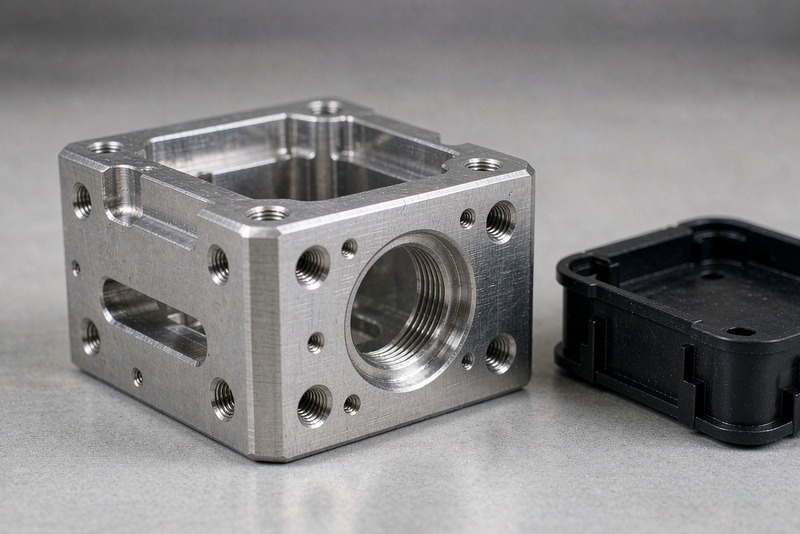
Injection molding vs CNC machining is a split in cost structure rather than in precision. Molding puts most of the money into a tool before the first good part exists, then runs parts cheaply once that tool is proven. Machining puts money into programming, fixturing and cutting time, with no tool to carry and no gate to trim.
That difference decides most of the argument. What is left comes down to geometry, material, cosmetic expectations, and how likely the design is to move after the first samples are approved.
Injection Molding vs CNC Machining: Where the Routes Diverge
Molding fills a cavity with melted resin under pressure. The cavity is a block of hardened steel cut to the inverse of the part, and every feature the part needs — draft, radii, gate position, ejector layout — has to exist in that steel before production starts. Machining starts from a billet and removes material with a rotating cutter, so the tooling is a program and a fixture that can be edited in an afternoon.
The practical consequence is that molding rewards certainty and machining rewards change. A buyer still arguing about wall thickness with the design team is usually better served by a machined batch than by a mold.
The Quantity Crossover Is About Tooling, Not Speed
A single-cavity mold for a small housing is commonly priced in the thousands of dollars. A machined batch of the same part has no comparable entry cost, which is why the quoted piece price can look absurd at 50 pieces and competitive at 50,000.
Run the comparison at the quantities you will actually release, not at the annual forecast. If the annual volume is 20,000 but arrives in four releases, the tool still has to be justified against a machining route that only carries setup for a few days. The cost per part at different quantities is driven by setup amortization as much as by cycle time.
The crossover is not a fixed number. Cavity count, part size, resin, polish level and the tolerance band all move it, which is why two shops can quote the same step change at different volumes and both be right.
Design Rules That Change With the Process
A molded part needs draft so it can leave the cavity, wall sections that fill evenly, and radii that let resin flow instead of stalling. Sharp internal corners concentrate stress and wear the tool, and a thick section next to a thin one produces a sink mark on the visible face.
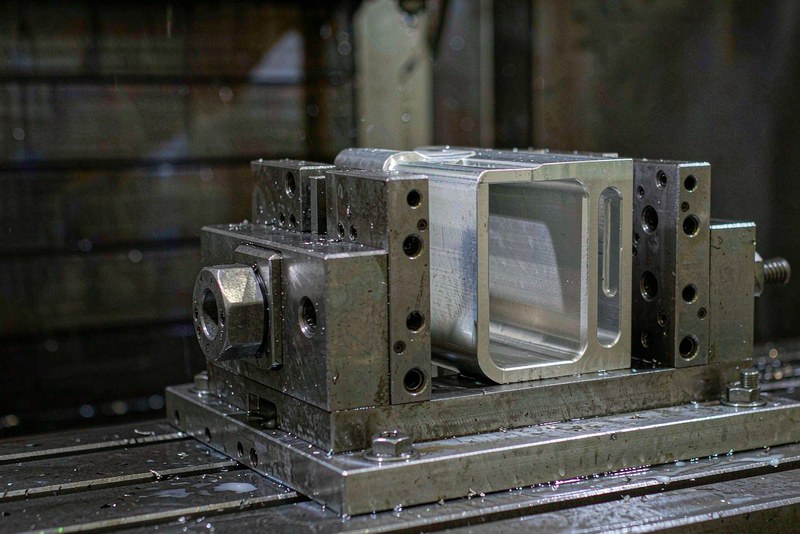
A machined part tolerates sharp external edges and deep pockets, but the inside of a corner is limited by the cutter radius, and a thin wall will deflect under clamping pressure. Undercuts that are free in a mold usually need a second setup, a five-axis move or an EDM burn. Wall thickness and corner radius are the two constraints worth checking before either route is quoted, and the minimum wall thickness guide covers the machining side of that check.
The cosmetic side matters as much as the geometry. Molded surfaces carry gate marks, weld lines and ejector witness marks at fixed locations. Machined surfaces carry tool paths that can be blended out, though a mirror finish usually needs a separate finishing step.
Material: Resin Grades Versus Machined Stock
Molding opens up filled, flame-retardant and elastomer grades that cannot be bought as a billet. The trade is that flow direction changes the finished part: glass-filled resin is stronger along the flow and weaker across it, and a weld line is a real mechanical discontinuity rather than a cosmetic line.
Machining keeps the properties the mill certificate states, with no flow direction and no weld line. For a short run of structural brackets or manifolds, that predictability often outweighs the material cost, and the choice of engineering plastics can be made on service conditions rather than on moldability.
Some grades machine badly — soft, gummy, or highly abrasive when glass filled — so a resin chosen for molding does not automatically transfer to a machined prototype.
Lead Time and the Cost of a Late Change
Mold lead time is dominated by tool design, steel cutting, spotting and trials; the parts themselves are fast once the tool is signed off. A change after the cavity is cut means welding and re-cutting, or a new insert, and the schedule resets from that point.
On a machined part the same change is a program edit plus a new billet. That is why prototype quantities are usually machined even when the production plan is molding, and why a bridge order can cover the gap between design freeze and tool approval without committing to steel.
The cost of a late change is easy to underestimate because it rarely appears on a quote. It appears as a slipped launch, a re-run of first article inspection, and a second round of approval meetings.
Hybrid Routes Worth Considering
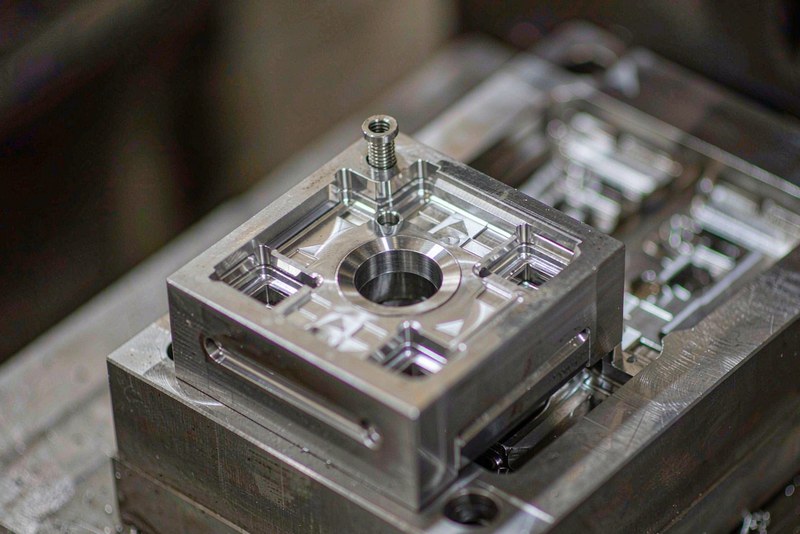
Two combinations come up often. The first is a machined pilot batch that proves fit and function while the mold is being built, so assembly issues surface before the tool is cut. The second is machined mold components: cavity inserts, slides and lifter details are cut on the same equipment, and their fit decides how the tool behaves on the first shot.
When the geometry is complex and the volume is genuinely small, neither route may be the answer. Additive processes can undercut both on parts that are expensive to hold and expensive to tool, and a comparison of 3D printing and machining is a faster way to rule one of them out than a formal quote.
A Decision Checklist for Injection Molding vs CNC Machining
Before the RFQ goes out, put these on one page:
- Annual volume, release quantity, and the buffer needed between releases.
- Features that require draft, slides or a second setup, and who owns the tool.
- Cosmetic requirements, including which faces are visible and which are hidden.
- Whether the resin is fixed by a specification you cannot change.
- How likely the design is to change in the first six months.
If the design is still moving, the machining route buys optionality that a mold cannot. If the volume is firm, the geometry is stable and the cosmetic callouts are agreed, injection molding vs CNC machining tends to resolve in favor of the tool, because piece price drops once the tool is amortized.