
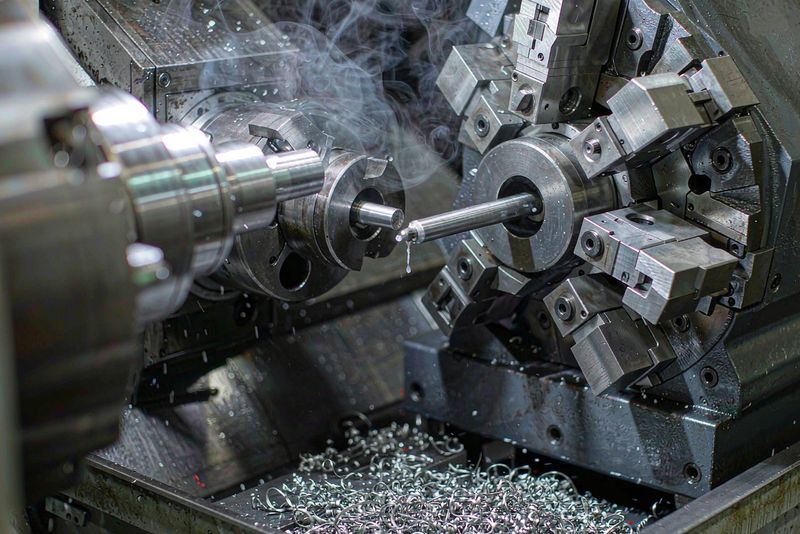
Swiss machining is what a shop quotes when a part is small in diameter, long relative to that diameter, and needed in volume. The machine behind it — a sliding headstock lathe with a guide bushing and tools packed around a narrow working zone — produces parts that a conventional lathe struggles to hold. The cost model differs from chucking work, and so do the drawing rules that apply.
What a Sliding Headstock Does Differently
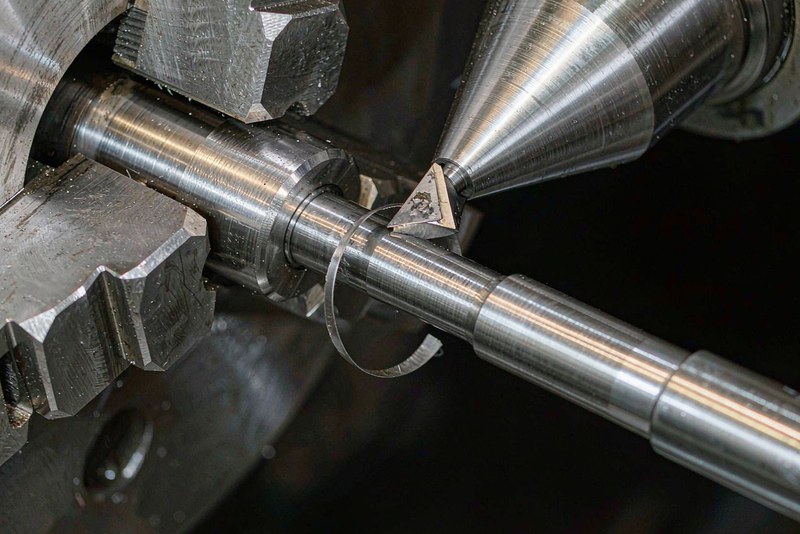
On a conventional lathe the part sits in a chuck or collet and the turret travels along it. On a sliding-headstock machine the bar moves instead: a guide bushing grips the bar immediately behind the cut, and the headstock pushes material through that bushing as the Z axis advances. The tool stays at the bushing face, so the work is supported within a millimeter or two of where the insert touches it.
That single detail explains most of the process. A slender part that would deflect and chatter in a chuck stays rigid, so diameters can be turned in one pass to a finish that would otherwise need a second operation. Typical bar capacity runs from roughly 20 mm to 32 mm, with larger models on the market.
Most machines carry a main and a sub-spindle, with cross drilling and milling stations between them. A part can be turned, drilled, tapped and parted off, then picked up by the sub-spindle and finished on the back face without being re-chucked. Where a part needs milled rather than turned features, the CNC milling vs CNC turning comparison sets out how the two routes divide the work.
Where Swiss Machining Beats a Conventional Lathe
Three part shapes favor the process.
The first is the long, small-diameter shaft. Once length-to-diameter passes roughly 3:1, chucking work starts to fight deflection, and the usual fixes are a tailstock, a steady rest, or lighter passes. Swiss turning removes the problem rather than managing it.
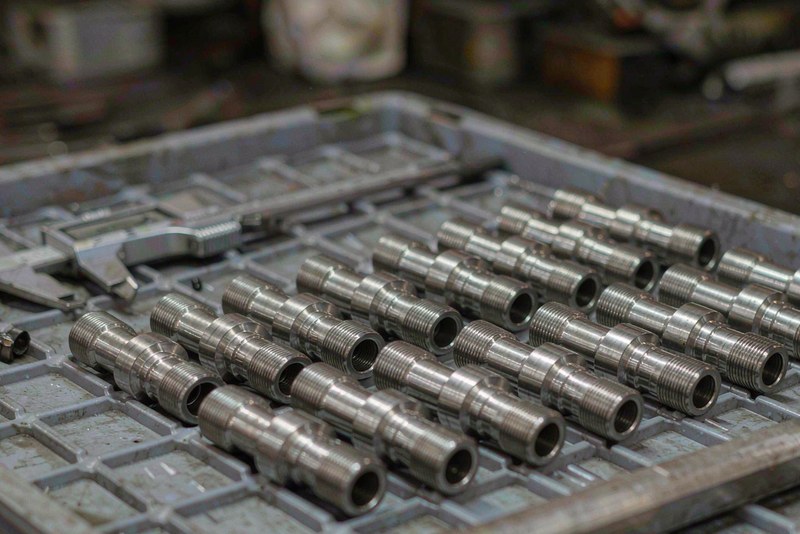
The second is the part with many features on a small envelope. Cross holes, flats, slots and threads on a 10 mm body are routine when the tools sit around the bushing and the sub-spindle handles the back.
The third is the part that would otherwise need three setups. Every re-chuck adds handling, a new datum and a new chance for error. When one machine completes the part, the quote loses two operations.
Design Rules Change Near the Guide Bushing
The bushing grips the bar on its original surface, and that has consequences for the drawing.
Bar stock tolerance matters more than most drawings admit. A guide bushing is set with a small clearance to the bar, so shops commonly ask for ground or precision-drawn stock rather than general cold-drawn bar. If the material on the drawing can only be met by standard bar, the shop either sources ground bar at a premium or turns the part another way.
Features near the parting line need thought. The last few millimeters are where the bushing was gripping, so turned detail there is limited, and cutoff leaves a burr on the back face that has to be planned for.
Threads are the other common sticking point. A thread that runs to a shoulder needs a relief groove or a runout length the tool can reach, and long threads on slender sections are usually cut with a die head or thread whirling rather than single-point turning. The thread design guide for CNC machined parts covers the relief and runout geometry.
Thin walls are feasible because the cut is supported, but the wall still has to survive cutoff and transfer to the sub-spindle; the minimum wall thickness guidance applies here as elsewhere.
Where the Cost Actually Sits
Four things drive a Swiss quote, and machining time is only one of them.
Bar utilization. You pay for bar, not for part. The bar diameter has to be the next size above the largest finished diameter, and a remnant stays in the feeder at the end of every bar. On a 30 mm part from 32 mm bar the loss is modest. On a 6 mm part from 8 mm bar it is not.
Setup and tooling. Multi-station setup, form tools and prove-out time are real costs, and they land on the first piece.
Cycle time. With overlapping operations, the per-part cycle on a small fitting can be measured in tens of seconds.
Secondary operations avoided. Deburring, back-face machining and in-process checks that a chucking shop would bill separately sit inside the cycle. That is the saving buyers tend to miss when comparing piece prices line by line.
When a Conventional Lathe Is the Better Call
Swiss machining is not a default. A part that is short and stiff — a 60 mm flange, 15 mm thick — gains nothing from a guide bushing, and will not pass through one at that diameter. Large diameters, heavy interrupted cuts and parts that need tailstock support belong on a chucking machine.
Low quantity is the other case. For five pieces the setup dominates, and a two-axis lathe with a simple fixture is usually cheaper even when the cycle is longer. The CNC machining cost by quantity breakdown shows how that curve behaves across process routes.
What to Put in the RFQ
A Swiss quote comes back accurate when the request states a few things plainly:
- Bar diameter you expect, or the largest finished diameter if you have not chosen one.
- Material condition: ground bar, cold-drawn, or whatever the specification requires.
- Quantity, and whether the order repeats; fixed cost is amortized differently at 200 pieces and at 20,000.
- Which features are critical, and the tolerance band on each.
- Back-face requirements: chamfer, deburr, or a fully machined face.
- Whether parts ship as-machined or need finishing coordination.
Mistakes That Show Up in Swiss Quotes
The most common is a drawing dimensioned from the bar end that nobody can machine. The second is a thread callout with no room for runout. The third is comparing a Swiss price against a chucking price without checking whether the chucking quote includes the second operation. Two more worth watching: a part diameter the machine cannot bar-feed, and a remnant per bar at low volume.
Bottom Line
Swiss machining earns its premium on slender, feature-dense turned parts in repeating quantities. Below a few hundred pieces, or above the bar capacity of the machine, the arithmetic usually favors a conventional lathe. The useful question is not which process is better, but which one your part shape and batch size actually fit.