
What Is 4-Axis CNC Milling?
4-axis CNC milling is a machining process that adds a rotary axis (typically the A-axis rotating around the X-axis) to the standard three linear axes (X, Y, Z). This allows the cutting tool to approach the workpiece from multiple angles without requiring manual repositioning. Compared to 3-axis machining, the fourth axis significantly reduces the number of setups needed for complex geometries, improves surface finish on contoured surfaces, and enables the machining of features such as helical slots, angled holes, and complex undercuts that would otherwise be difficult or impossible with 3-axis alone.
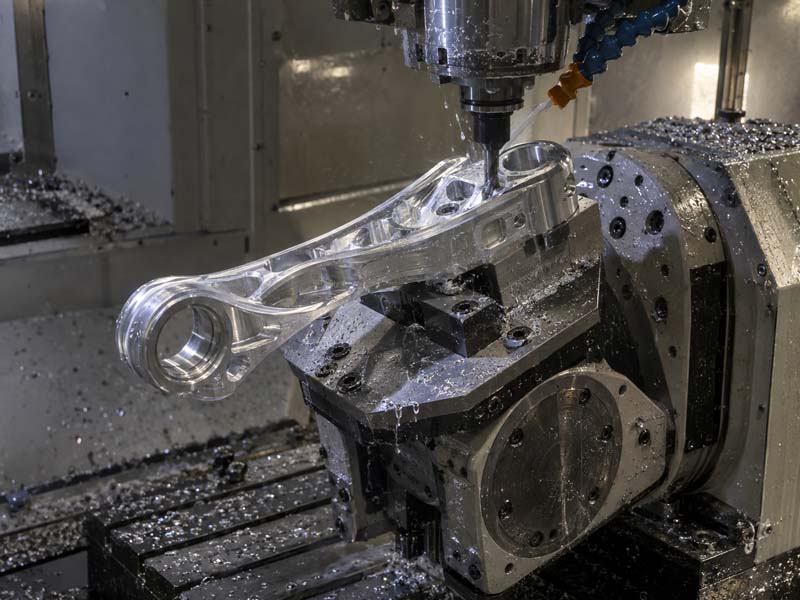
In practice, 4-axis milling is widely used for parts that require machining on multiple faces but do not need the full tilt capabilities of a 5-axis machine. Common applications include impellers, turbine blades, automotive components, medical device parts, and custom industrial machinery components. The fourth axis can be implemented as a rotary table (indexer) mounted on the machine bed, or as an integrated rotary axis in the machine's design.
Key Advantages of 4-Axis Over 3-Axis Machining
Reduced Setup Time and Higher Accuracy
With 3-axis machining, a part requiring work on five or six faces may need multiple setups, each introducing potential alignment errors. By rotating the part with the fourth axis, you can machine several faces in one clamping. This not only saves time but also improves dimensional consistency because all features are referenced from a single datum. For procurement professionals, this means faster lead times and lower risk of scrap due to setup misalignment.
Machining of Complex Geometries
4-axis milling enables cutting of helical paths, curved slots, and complex profiles that would require special fixtures or multiple operations otherwise. For example, a helical gear or a spiral groove on a shaft can be produced efficiently with simultaneous 4-axis interpolation. Engineers designing parts should consider how 4-axis capabilities can simplify tool access and reduce the need for custom workholding.
Improved Surface Finish
Because the workpiece can be rotated during cutting, the tool can maintain a more favorable engagement angle, reducing tool marks and improving surface quality. This is especially beneficial for contoured surfaces where a 3-axis approach would produce stepped or scalloped finishes requiring secondary polishing.
Design Considerations for 4-Axis Machining
To fully leverage 4-axis CNC milling, designers and engineers should keep a few practical guidelines in mind:
- Part orientation: Plan the rotation axis so that the majority of features are accessible in one or two setups. Avoid requiring the spindle to reach deeply into cavities with excessive tool overhang.
- Tool accessibility: Even with a rotary axis, long tools may still cause deflection. Keep deep pockets and internal corners with adequate radii to allow standard tool lengths.
- Workholding: Rotary fixtures or collet chucks must provide enough grip force without deforming thin-walled sections. Consider adding locating features or soft jaws for delicate parts.
- Tolerance stack: While 4-axis reduces setup errors, each rotation introduces its own rotary positioning tolerance. For high-precision features, specify critical dimensions that are machined in the same orientation.
For a deeper understanding of how part geometry impacts machining cost and feasibility, refer to our CNC Machining Services page, where we discuss design review and DFM optimization.
When to Choose 4-Axis vs. 5-Axis Machining
Choosing between 4-axis and 5-axis milling depends on part complexity, production volume, and budget. Here is a practical comparison:
| Factor | 4-Axis Milling | 5-Axis Milling |
|---|---|---|
| Part complexity | Multiple faces, helical features, undercuts not requiring simultaneous tilt | Complex freeform surfaces, deep cavities with undercut, turbine blades, molds |
| Setup reduction | Typically reduces 3-axis setups from 3–5 to 1–2 | Can machine most parts in one setup |
| Tool cost | Lower (standard tooling) | Higher (needs shorter rigid tools, possibly custom) |
| Machine hourly rate | Lower than 5-axis | Higher due to machine complexity and maintenance |
| Accuracy | Very good for most applications | Excellent for complex contours |
If your part can be machined in two or three setups on a 4-axis machine, it is often more cost-effective than using a 5-axis machine. However, if a part has severe undercuts or requires continuous tilt to maintain tool engagement, 5-axis becomes necessary. Discuss your part geometry with an experienced machining partner to determine the best process.
Cost Implications of 4-Axis Milling
Adding a fourth axis does increase the machine purchase cost and sometimes the programming time, but the overall cost per part often decreases due to fewer setups, reduced labor, and lower scrap rates. For low-volume production (10–500 pieces), the savings in setup time can be substantial. For high-volume runs, dedicated fixtures on 3-axis machines might still be more economical, but 4-axis can still reduce handling if multiple operations are needed.
When requesting a quote, provide a detailed drawing with critical tolerances and surface finish requirements. A 4-axis capable shop can quickly evaluate whether your part benefits from rotary indexing. For more on cost drivers, see our CNC Machining Cost Guide.
Quality Assurance for 4-Axis Machined Parts
Inspection of 4-axis parts requires checking not only linear dimensions but also angular positions and concentricity features rotated across different faces. CMM inspection with a rotary probe or dedicated gauges is commonly used. Ensure your supplier has the capability to measure features machined on the fourth axis, including true position of holes relative to a datum plane. A reliable machining partner will include these checks in their quality plan.
At Hongke Precision, our engineering team reviews every project to optimize machining strategy, tool selection, and inspection criteria. Contact us to discuss your next 4-axis CNC milling project.