
Why Stainless Steel Pipe Fittings Require Specialized CNC Machining
Stainless steel pipe fittings are essential components in fluid handling systems, from hydraulic lines and pneumatic controls to water treatment and chemical processing. Unlike carbon steel or aluminum, stainless steel presents unique machinability challenges due to its high work-hardening rate, low thermal conductivity, and tendency to form built-up edge. A standard general-purpose CNC program developed for aluminum will not produce acceptable results on a stainless steel fitting. The material demands slower cutting speeds, higher rigidity, proper tool geometry, and effective coolant delivery. For procurement professionals and design engineers, understanding how these factors affect machining feasibility, lead time, and cost is critical when specifying custom pipe fittings.
This guide covers the practical aspects of CNC milling and turning of stainless steel pipe fittings—from material grade selection and toolpath strategies to tolerances, surface finish, and volume production considerations. It is intended for engineers who design fittings and for buyers who evaluate CNC machining suppliers for pipe fitting projects.
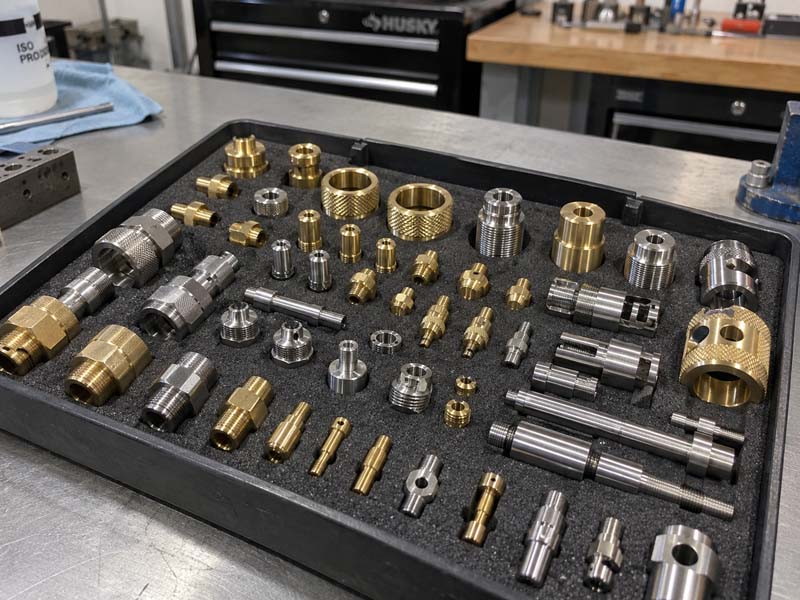
Common Stainless Steel Grades for Pipe Fittings and Their Machinability
Austenitic Stainless Steels (304, 316, 316L)
The largest group of stainless steel used for pipe fittings is the austenitic family, particularly grades 304 and 316/316L. The “L” designation indicates a low carbon content, which reduces the risk of sensitization during welding and improves corrosion resistance in aggressive environments. From a machining perspective, austenitic stainless steels have high ductility and work-harden rapidly. The work-hardening layer makes each subsequent cut more difficult, so the first cut must penetrate below the previous work-hardened surface. Sharp tooling with positive rake angles and constant feed engagement are essential. Typical cutting speeds for 304/316 on CNC turning centers range from 80 to 120 m/min using carbide inserts, while milling speeds are around 50 to 100 m/min depending on tool diameter.
Martensitic Stainless Steels (410, 416)
Martensitic grades are magnetic and can be heat-treated to high hardness. They are less common for standard pipe fittings but appear in applications requiring wear resistance or higher strength at moderate temperatures. Grade 416 contains added sulfur to improve machinability, making it one of the easiest stainless steels to cut. However, its corrosion resistance is lower than 304 or 316. Machinability of 416 is comparable to free-machining brass in some respects, with cutting speeds up to 180 m/min possible.
Ferritic Stainless Steels (430)
Ferritic grades offer moderate corrosion resistance and are magnetic. They work-harden less than austenitic steels but still require sharp tools and adequate cooling. Grade 430 is often used in automotive exhaust fittings and appliances. Machinability is slightly better than 304, but chip control can be more difficult due to longer, stringy chips.
Duplex Stainless Steels (2205, 2507)
Duplex grades combine high strength with excellent corrosion resistance, making them popular for offshore oil and gas, chemical, and marine fittings. Duplex stainless steels have higher tensile strength and lower elongation compared to austenitics, which produces higher cutting forces and tool wear. They also work-harden significantly. Machining duplex requires rigid setups, negative rake inserts with chip breakers, and reduced cutting speeds—typically 60 to 90 m/min for turning.
Selecting the Right Grade
As a general rule, 316L offers the best combination of corrosion resistance and machinability for custom pipe fittings. If machining cost is a primary concern and the application does not require high corrosion resistance, 304 or even 416 can reduce cycle time. For severe service conditions, duplex or super-austenitic grades may be necessary, but expect increased machining time and tool consumption. Always confirm the material specification with the end-user environment.
Key Machining Processes for Stainless Steel Pipe Fittings
CNC Turning (OD and ID)
Most pipe fittings start as bar stock or forgings and are first turned on a CNC lathe. The external profile, threads, chamfers, and internal bores are created through turning, boring, threading, and parting operations. For stainless steel, a high-rigidity machine with a powerful spindle (preferably 15 HP or more) is recommended. The use of high-pressure coolant (70–100 bar) helps break chips and evacuate heat from the cutting zone. Threading on stainless steel pipe fittings is commonly done with single-point threading tools for NPT or BSP threads, or with thread milling for larger diameters. When turning, maintaining constant chip load and avoiding dwell marks are critical. A dwell can cause work-hardening and create a hard spot that breaks the insert on re-entry.
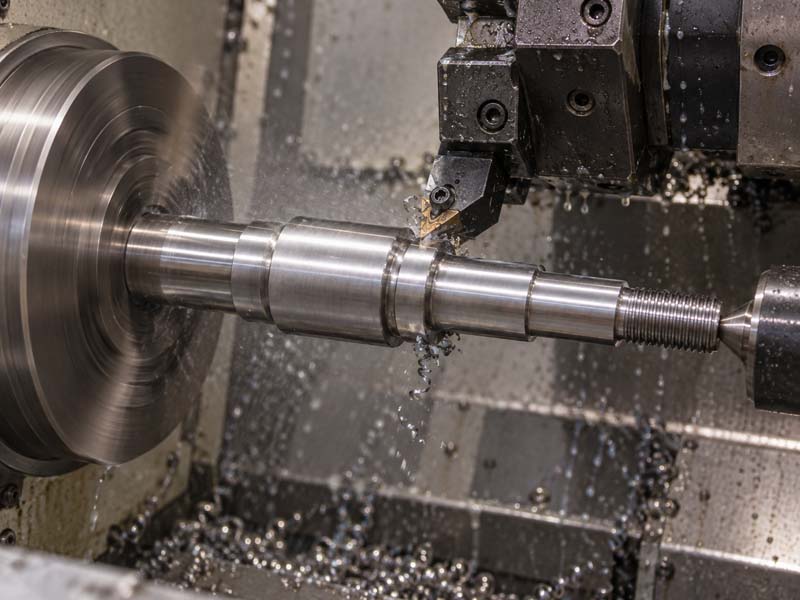
CNC Milling for Complex Features
Pipe fittings often need flats, slots, hexagonal wrench flats, keyways, or port holes. These features require CNC milling, usually on a 3-axis or 4-axis machine. When milling stainless steel, climb milling is preferred to reduce work-hardening and improve surface finish. Tools should be solid carbide with TiAlN or AlTiN coatings. For deep slots or thin walls, incremental finishing passes and proper coolant direction are essential. When machining hexagons on fitting ends, a single setup using a live tool on a CNC Swiss or mill-turn machine can produce the entire part in one operation.
Hole Machining and Boring
Many pipe fittings require through-holes, counterbores, or tapered holes. Drilling stainless steel requires a rigid setup and a coolant-fed drill to prevent work-hardening. High-speed steel drills are rarely used today; instead, solid carbide or exchangeable-tip drills with internal coolant are standard. For high-precision bores (e.g., where O-rings seal), boring bars with coated carbide inserts and a finishing pass of 0.1–0.3 mm are typical. Tolerances of ±0.025 mm on bore diameters are achievable with careful process control.
Workholding and Setup Considerations
Stainless steel pipe fittings are often small to medium-sized parts (from 1/8” nominal pipe size up to 2” or 3”). Workholding must provide high clamping force without damaging the surface. Standard three-jaw chucks with soft jaws or collet chucks are common for turned parts. For hex or square profiles, specially machined collets or custom fixtures may be required. Due to the high cutting forces generated during stainless machining, robust fixturing is critical. Any vibration or slipping will quickly produce chatter marks, oversized dimensions, or tool breakage.
For secondary milling operations, a vise or modular fixture with locating pins is often used. When tolerances are tight, a datum transfer system should be employed. For instance, turning is completed first, then the part is transferred to a milling fixture referencing the turned bore or face. The number of setups directly affects part concentricity and tolerance stack-up. A single-setup approach on a multi-tasking machine (e.g., mill-turn or B-axis lathe) is ideal for complex fittings.
Tolerances and Dimensional Inspection for Stainless Steel Fittings
Pipe fittings typically have both functional and thread dimensions that require tight control. Common tolerances for custom stainless steel fittings include:
- Bore or passage diameters: ±0.05 mm (typical), ±0.025 mm (precision)
- Thread pitch diameter: according to NPT/BSP standards (e.g., 1/2” NPT per ASME B1.20.1)
- Hexagonal width across flats: ±0.1 mm
- Concentricity of threads to bore: 0.05 mm TIR
- Surface roughness: 3.2 µm Ra (general), 1.6 µm Ra (sealing surfaces)
Inspection of stainless steel fittings often involves go/no-go thread gauges, profile projectors for thread form, CMM for geometric tolerances, and surface roughness testers. For high-pressure applications, hydrostatic testing or helium leak testing may be specified. When reviewing a drawing for stainless steel fittings, pay special attention to thread specification (NPT, BSPT, BSPP, etc.), pressure rating, and any required material certifications (e.g., EN 10204 3.1).
Surface Finishing and Post-Machining Treatments
Stainless steel fittings may require specific surface finishes for corrosion resistance or aesthetic reasons. Common post-machining processes include:
- Passivation: Removes free iron and other contaminants from the surface, restoring the natural chromium oxide layer. This is standard for austenitic and ferritic fittings used in food, pharmaceutical, or medical applications.
- Electropolishing: Produces a smooth, bright surface with improved corrosion resistance. It is often specified for sanitary fittings.
- Mechanical polishing: Used for cosmetic appearance on visible parts. Can be done by hand or with abrasives, but care must be taken not to overheat the surface.
- Shot blasting: Produces a uniform matte finish and can remove minor surface defects. However, it may reduce corrosion resistance if not followed by passivation.
- No finish (as-machined): Many industrial fittings are used in the as-machined condition, provided the surface roughness meets the drawing requirement.
When ordering surface treatments, confirm that the finishing process does not affect critical dimensions. Passivation and electropolishing remove a small amount of material (typically 0.0002–0.0005 mm), which can affect tight bores. Often finishing is performed after final machining, with dimensional inspection following the treatment.
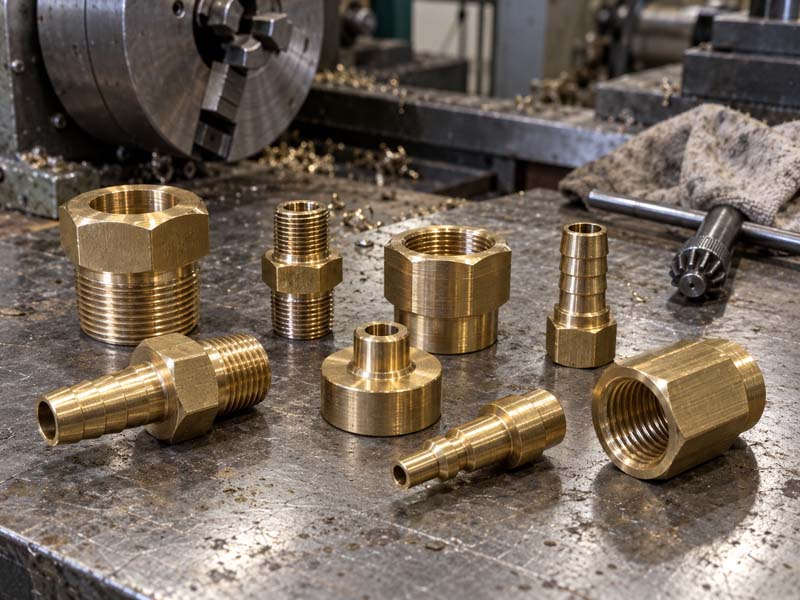
How Part Design Affects Stainless Steel Fitting Machining Cost
Several design features have a direct impact on machining time and tool cost for stainless steel pipe fittings:
- Thread type and length: NPT threads require a taper, which can be machined on a lathe with straight or taper turning. Longer threads increase cutting time and may require multiple passes. Thread milling is slower than single-point threading but necessary for certain geometries.
- Thin wall sections: Stainless steel’s lower thermal conductivity means heat builds up quickly in thin walls, causing expansion and potential chatter. Wall thickness below 1.5 mm should be avoided unless absolutely necessary, or alternative materials like 416 (free-machining) should be considered.
- Complex internal features: Cross-drilled ports, intersecting bores, or internal grooves increase the number of setups and special tooling. Each additional operation adds programming, setup, and inspection time.
- Tight tolerances on non-critical dimensions: Over-tolerancing (e.g., calling ±0.01 mm on a hex face that only needs to fit a wrench) increases cost without functional benefit. Focus tight tolerances on sealing surfaces and thread pitch diameters.
- Quantity: Low-volume (1–50 pcs) often requires manual programming, simple fixtures, and standard tooling. Medium volume (100–1000 pcs) allows amortization of custom carbide tooling and fixtures. High volume (>1000 pcs) can justify dedicated process design and automation.
What to Include in an RFQ for Stainless Steel Pipe Fittings
To receive an accurate quotation for custom CNC machined stainless steel pipe fittings, provide the following information:
- Complete 2D drawing with all dimensions, tolerances, and thread specifications (include GD&T if critical).
- 3D CAD model (STEP or IGES) for complex geometry.
- Material grade (e.g., 316L, 304, 2205) and any required material certification (e.g., ASTM A276, ASTM A479).
- Quantity and expected annual usage.
- Surface finish requirements (Ra value, passivation, electropolishing, etc.).
- Inspection requirements: CMM report, thread gauge, hardness test, pressure test?
- Any special packaging or labeling.
- Preferred delivery lead time.
A reputable CNC machining manufacturer will review your drawing and provide DFM feedback. For example, they may suggest adjusting a thread relief undercut to improve tool life, or changing a sharp internal corner to a radius to avoid a special end mill. Such feedback can save 15–30% in machining cost without sacrificing function.
Selecting a Supplier for Stainless Steel Pipe Fittings
Not all machine shops are equally experienced with stainless steel. When evaluating suppliers for custom pipe fitting projects, consider the following:
- Experience with austenitic and duplex materials: Ask for examples of similar fittings they have produced, and what challenges they encountered.
- Machine capability: Do they have CNC lathes with high-pressure coolant? Live tooling? Multi-slide capability? A mill-turn machine can reduce setups for hex, slot, and cross-hole features.
- In-house inspection equipment: CMM, thread gauges, profilometer, etc. This ensures faster turnaround and better communication.
- Material sourcing: Can they source certified stainless steel bar stock or forgings? Do they have relationships with suppliers of traceable material?
- Quality system: ISO 9001 is standard for precision machining; AS9100 may be needed for aerospace applications.
- Communication: The supplier should be willing to discuss tolerances, tooling, and potential cost reductions. A “black box” approach where they simply quote your drawing without questions is a red flag.
An experienced machining partner will help you avoid common pitfalls such as selecting too tight a thread tolerance that cannot be reliably achieved, or specifying a surface finish that requires an expensive secondary operation when an as-machined finish would be sufficient. By understanding the material behavior and machining process, you can design better parts and make more informed procurement decisions.
For more information on how we approach stainless steel pipe fitting projects, see our CNC machining services page or submit an RFQ with your drawing.